
Was looking over this today, most of you have probably read it before, but it is a good, factual, well told story.
A bit before our time, but see if you can recognize any similarities.
Chapter One - The Attack
First of all, I wish to give an account of the attack and tell of the famous incident of July, 1924, when the "Hairy Apes" attacked our cabin. We had been prospecting for six years in the Mt. St. Helens and Lewis River area in Southwest Washington. We had, from time to time, come across large tracks by creek beds and springs. In 1924 I and four other miners were working our gold claim, the Vander White. It was two miles east of Mt. St. Helens near a deep canyon now named "Ape Canyon" — which was so named after an account of the incident reached the newspapers.
Hank, a great hunter and good woodsman, was always a little apprehensive after seeing the tracks. The tracks were large and we knew that no known animal could have made them: the largest measured nineteen inches long.
It was in the middle of July, and we had received a good assay on our claim, and everyone was excited. I remember I had a tooth that was aching, and I suggested to Hank that he should take me to town to see a dentist; but he was so enthused in the prospects of the gold mine, he barely took time to answer me. He replied that "God or the Devil" could not get him away from there. We had all come up in his Ford, and I had no way to get to town unless he took me. So when we went back to our cabin, on the north side of the canyon, I had a nagging tooth ache and little appetite for our evening meal of beans and hotcakes.
Hank, though apprehensive, was still determined. We had been hearing noises in the evening for about a week. We heard a shrill, peculiar whistling each evening. We would hear it coming from one ridge, and then hear an answering whistling from another ridge. We also heard a sound which I could best describe as a booming, thumping sound — just like something was hitting its self on its chest.
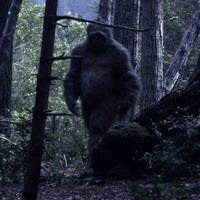
Hank asked me to accompany him to the spring, about a hundred yards from our cabin, to get some water, and suggested we take our rifles — to be on the safe side. We walked to the spring, and then, Hank yelled and raised his rifle, and at that instant, I saw it. It was a hairy creature, and he was about a hundred yards away, on the other side of a little canyon, standing by a pine tree. It dodged behind the tree, and poked its head out from the side of the tree. And at the same time, Hank shot. I could see the bark fly out from the tree from each of his three shots. Someone may say that that was quite a distance to see the bark fly, but I saw it. The creature I judged to have been about seven feet tall with blackish-brown hair. It disappeared from our view for a short time, but then we saw it, running fast and upright, about two hundred yards down the little canyon. I shot three times before it disappeared from view.
We took the water back to the cabin, and explained the affair to the rest of the party; and we all agreed, including Hank, to go home the next morning as it would be dark before we could get to the car. We agreed it would be unsound to be caught by darkness on the way out.
Nightfall found us in our pine-log cabin. We had built the cabin ourselves, and had made it very sturdy. It stood for years afterward, and was visited by many sight seers until a few years ago when it was burned to the ground — the circumstances of the fire, I do not recall.
In the cabin, we had a long bunk bed in which two could sleep, feet to feet — the rest of us sleeping on pine boughs on the floor. At one end of the cabin, we had a fireplace, fashioned out of rocks. There were no windows in the cabin. So darkness found all of us in the cabin, more calm now (and my tooth was better, somehow the excitement seemed to work a temporary cure on it). We were sitting around, puffing on pipes, and talking about the trip home the next day.
Each of us settled down in his crude, but welcomed bed, and soon fell asleep. About midnight, we were all awakened. Hank, who was sleeping on the floor was yelling and kicking. But the noise that had awakened us was a tremendous thud against the cabin wall. Some of the chinking had been knocked loose from between the logs and had fell across Hank's chest. He had his rifle in his hand and was waving it back and forth as he kicked and yelled. (Hank always slept with his gun near by — it was a Remington automatic, my gun being a 30-30 Winchester, which I still have).
I helped to get the chinking off him, and he jumped to his feet. Then, we heard a great commotion outside: it sounded like a great number of feet trampling and rattling over a pile of our unused shakes. We grabbed our guns. Hank squinted through the space left by the chinking. By actual count, we saw only three of the creatures together at one time, but it sounded like there were many more.
This was the start of the famous attack, of which so much has been written in Washington and Oregon papers through out the years. Most accounts tell of giant boulders being hurled against the cabin, and say some even fell through the roof, but this was not quite the case. There were very few large rocks around in that area. It is true that many smaller ones were hurled at the cabin, but they did not break through the roof, but hit with a bang, and rolled off. Some did fall through the chimney of the fireplace. Some accounts state I was hit in the head by a rock and knocked unconscious. This is not true.
The only time we shot our guns that night was when the creatures were attacking our cabin. When they would quiet down for a few minutes, we would quit shooting. I told the rest of the party, that maybe if they saw we were only shooting when they attacked, they might realize we were only defending ourselves. We could have had clear shots at them through the opening left by the chinking had we chosen to shoot. We did shoot, however, when they climbed up on our roof. We shot round after round through the roof. We had to brace the hewed-logged door with a long pole taken from the bunk bed. The creatures were pushing against it and the whole door vibrated from the impact. We responded by firing many more rounds through the door. They pushed against the walls of the cabin as if trying to push the cabin over, but this was pretty much an impossibility, as previously stated the cabin was a sturdy made building. Hank and I did most of the shooting — the rest of the party crowded to the far end of the cabin, guns in their hands. One had a pistol, which still is in my family's possession, the others clutched their rifles. They seemed stunned and incredulous.
The attack continued the remainder of the night, with only short intervals between. A most profound and frightening experience occurred when one of the creatures, being close to the cabin, reached an arm through the chinking space and seized one of our axes by the handle (a much written about incident and a true one). Before the thing could pull the axe out, I swiftly turned the head of the axe upright, so that it caught on the logs; and at the same time Hank shot, barely missing my hand.
The creature let go, and I pulled the handle back in, and put the axe in a safe place.
A humorous thing I well remember was Hank singing: "If you leave us alone, we'll leave you alone, and we'll all go home in the morning." He did not mean it to be humorous, for Hank was dead serious, and sang under the impression that the "Mountain Devils" as he called them, might understand and go away.
The attack ended just before daylight. Just as soon as we were sure it was light enough to see, we came cautiously out of the cabin.
It was not long before I saw one of the apelike creatures, standing about eighty yards away near the edge of Ape Canyon. I shot three times, and it toppled over the cliff, down into the gorge, some four hundred feet below.
Then Hank said that we should get out of there as soon as possible; and not bother to pack our supplies or equipment out; "After all," he said, "it's better to lose them, than our lives." We were all only too glad to agree. We brought out only that which we could get in our packsacks. We left about two hundred dollars in supplies, powder, and drilling equipment behind.
I tried to persuade everyone not to relate the happenings to anyone, and they agreed, but Hank soon let the cat out of the bag. We made our way to Spirit Lake, and Hank went in to the ranger station. He had told the ranger earlier about the tracks, and the ranger had replied, "Let me know if you find out what they are." That was just what Hank did, to the puzzlement of the ranger.
When we were back home in Kelso, Washington, he told some of his friends, and somehow the story leaked out to the papers, and the Great Hairy Ape Hunt of 1924 was on.
Local reporters interviewed us. They came from Portland and Seattle — even a big game hunter from England came asking questions, and he had a large gun with him that must have been an elephant gun. Many people flocked to the Mt. St. Helen's area looking for the "Great Hairy Apes", or "Mountain Devils." I, myself, went back with two reporters and a detective from Portland, Oregon. We found large tracks, and they photographed them. We did not see any of the Apemen then, nor could we find the ones we had shot.
So people were asking questions: Was it true? Or was it just a wild tale? I can assure you it is true. Are they human? animal? or devils? I will answer that question in this book. That was a great "Apehunt" in 1924, and the last few years, more and more people have reported seeing them. There is an Apehunt being revived again, and another man has written a book on the subject and has formed a club whose purpose is to find evidence to prove what they already believe: that abominable snowmen of America do exist.
A wealthy person has offered a large sum of money for anyone that can capture one alive. Sightings have been reported in Canada, Washington, Oregon, and northern California. But the purpose of this book, is not only to relate my experiences, but also to bring to light my knowledge about the Abominable Snowmen. I do not wish to embark upon an expedition, but I wish to tell what these beings are.
Chapter Two
Longview Daily News (Sat-Sun, June 27-28, 1964)
LEGENDARY MT. ST. HELENS APEMEN CALLED LEGITIMATE
The legend of the apemen of Mt. St. Helens returns, like hay fever, with summer weather.
The story of the apemen of the beautiful conical mountain situated in the Cascade Range of Southwest Washington, is a favorite in the area, but it just may have some basis in fact.
There is more basis to support it than Nepal's Yeti or northern California's "Big Foot" and probably as much as Loch Ness' monster.
Last summer, two different Portland groups who visited the region reported sighting the monsters, usually described as from 7 to 10 feet tall, hairy and either white or beige-colored.
Three persons in a car on a lonely forest road said they saw one of the creatures when it flashed across the headlight beams of their car near the wilderness area which includes such places as "Ape Canyon."
A Portland couple fishing on the Lewis River south of the mountain saw a huge beige figure "bigger than any human" amble off into the brush.
Old timers aren't surprised, just amused. The apeman legend actually is older than the white man's habitation of the Pacific Northwest.
Indian Legend
Forestry employes have investigated many reports of the strange creatures. According to Indian legend, the "apes" were the ferocious Selahtik Indians, a band of renegades much like giant apes in appearance who lived like wild animals in the secluded caves of the Cascades.
The first recorded encounter of the apes with white men was in 1924. A group of five prospectors rushed into Kelso to report that a group of great, ape-like creatures had attacked them in the middle of the night.
The miners said they had been working a mine on the east slopes of Mt. St. Helens. During the daytime, they saw some of the apes and fired at them to halt an apparent attack. One of the apes appeared to have been hit and rolled into a deep ravine. That night, according to the account, the apemen hurled rocks onto the cabin and "danced and screamed until daylight."
Then came the "great ape hunt 0f 1924." Law enforcement officers and a flock of newspapermen made up a posse that went into the area. The armed searchers fired at anything that moved, so the report went. They returned to tell of finding huge footprints, but no apes.
The legend grew from that point for several years, then subsided with only sporadic reports of traces of the apes. Responsible persons, experienced mountaineers and skiers, have given credence to the story.
Bob Lee of Portland, a leader of the 1961 Himalayan expedition and adviser to last year's Himalayan expedition, said last year he had a strange experience. Lee has never claimed to have seen the apes, but said "there was something strange on the high slopes of the mountain."
He was a member of a party that searched for Jim Carter, an experienced skier and mountaineer, who vanished on the mountain in 1950. His disappearance remains a mystery.
Somebody Watched
At the time, Lee was a member of the Seattle Mountain Search and Rescue unit. He described the search for Carter as "the most eerie experience I ever had." He said that every time he was cut off from the rest of the search party he felt "somebody was watching me."
Carter, he said, had climbed the mountain with some companions on a warm, clear Sunday. He left the group to take a picture and said he would ski to the left of the group. He was never seen again.
His tracks, however, indicated that he suddenly took off down the mountain in a wild, death-defying run that no experienced skier would make — unless he was pursued, Lee said.
The track went in the direction of Ape Canyon. But no trace of Carter or his equipment was found although the area was combed for two weeks. Lee recalled stories of about 25 persons who claim they had encountered the monsters during a 20 year period.
The canyon named for the apes, is a lonely, ominous spot in a wild area. It extends to a point near Ape Cave, thought to be the longest unitary lava tube in the world.
There have been many reports of footprints in the area. Some are described as being about 18 inches long and seemingly human.
Unless the creatures are really fuzzy throwbacks, the lost Indian tribe theory seems most likely to some of the fans of the mystery. It has given rise to some suggestions, one of which is to leave well enough alone. The government might take over and shove benefits and subsidies at them — retroactive to the Ice Age.
And that, as well as costing a lot of money, would ruin a very good legend.
Like I said, a good telling of the story!
Hope you are all well and I hope to see some of you shortly!
The Ape Canyon Incident
-
hairy lad
- Silver Status
- Posts: 136
- Joined: Mon Mar 01, 2010 1:48 pm
- Position: Field Researcher
- Location: Canberra
-
mad_elaine

- Bronze Status
- Posts: 57
- Joined: Tue Nov 09, 2010 1:50 pm
- Position: Nature Lover
- Gender: Female
Re: The Ape Canyon Incident
Hmmmm. My ears certainly pricked up at the end, where they mention the lava tube. There is a very large lava tube in Northern NSW near Nimbin rock. The story I was told was that the initiation of kadaicha men involved using their "feather feet" to sneak to the yowie's nest and bring back some hair. I do know that the lava tube there starts in a valley where my parents live and goes all the way to Dunoon - some kilometres away. This would seem a perfect hideout nest for Yowies as not many know about it and nobody ever goes into them or even knows exactly where they are. Sounds like a suicide mission going into them to me! 
But I bet there is plenty of evidence in them. Oh well.
But I bet there is plenty of evidence in them. Oh well.
There are more things in heaven and earth, Horatio,
Than are dreamt of in your philosophy.
I don't have OCD, I just have ATD - attention to detail.
Than are dreamt of in your philosophy.
I don't have OCD, I just have ATD - attention to detail.