
Hi Y B
No mate my report was never added anywhere to the best of my knowledge and I do not have it in my messages any more. I do remember getting a reply from admin after I sent it in. Do not have that either.That was not long after I registered on forum No probs.
That is why I just gave the link to that other indentical report to save me writing it out again. Only thing the indentical report did not mention was where on river the boat ramp was.
Another interesting point about Brookyn is a system of caves on the hill up behind the mariner. These caves have been inhabited continuously by mostly same homeless elderly men for many decades now. These caves are not far from where I had my experience.
Another encounter my indigenous friend told me of was one night sitting around a camp fire and a hairy man/jungadee suddenly turned up and run around fire many times at incredible speed which caused the fire to go out. The jungadee then moved away from area and the fire restarted.
Another thing my friend said is to be friendly to them and also offer them food.
I have sent an email off to NPWS with my contact details re the photo and its history/interpretation.
Cheers
WARNING TO ABORIGINAL PERSONS pics of decesed persons inside
-
TheBlackStump
- Gold Status - Frequent Poster
- Posts: 360
- Joined: Sat May 07, 2016 7:58 am
-
TheBlackStump
- Gold Status - Frequent Poster
- Posts: 360
- Joined: Sat May 07, 2016 7:58 am
Re: WARNING TO ABORIGINAL PERSONS pics of decesed persons in
Found subject pic of this thread on a facebook page. See comments from indigenous persons. Plus a couple of other interesting pics with comments. Maybe pics 2 or 3 have been posted on the forum already.
https://www.facebook.com/IndigenousGhos ... =3&theater
… Noongar people are very spiritual people and you know if you do something, if you kill something for the fun of it then you know something will happen to you so you know you were taught that and you were taught about rules. You know when we sit around a campfire you’re not allowed to whiz the sticks around because you’ll bring the mummaries and woordatjis up. That’s the spirits. So you know growing up in the bush … where the rules were pretty well known.
https://www.facebook.com/IndigenousGhos ... =3&theater
https://www.facebook.com/IndigenousGhos ... =3&theater
https://www.facebook.com/IndigenousGhos ... =3&theater
… Noongar people are very spiritual people and you know if you do something, if you kill something for the fun of it then you know something will happen to you so you know you were taught that and you were taught about rules. You know when we sit around a campfire you’re not allowed to whiz the sticks around because you’ll bring the mummaries and woordatjis up. That’s the spirits. So you know growing up in the bush … where the rules were pretty well known.
https://www.facebook.com/IndigenousGhos ... =3&theater
https://www.facebook.com/IndigenousGhos ... =3&theater
-
Yowie bait
- Long Time Contributor
- Posts: 2530
- Joined: Wed Jan 13, 2016 5:06 pm
- Position: Believer
Re: WARNING TO ABORIGINAL PERSONS pics of decesed persons in
Thats interesting about the fellas living in the caves. Maybe someone should ask them if theyve seen anything. Bet theyd have a few tales...TheBlackStump wrote:Hi Y B
No mate my report was never added anywhere to the best of my knowledge and I do not have it in my messages any more. I do remember getting a reply from admin after I sent it in. Do not have that either.That was not long after I registered on forum No probs.
That is why I just gave the link to that other indentical report to save me writing it out again. Only thing the indentical report did not mention was where on river the boat ramp was.
Another interesting point about Brookyn is a system of caves on the hill up behind the mariner. These caves have been inhabited continuously by mostly same homeless elderly men for many decades now. These caves are not far from where I had my experience.
Another encounter my indigenous friend told me of was one night sitting around a camp fire and a hairy man/jungadee suddenly turned up and run around fire many times at incredible speed which caused the fire to go out. The jungadee then moved away from area and the fire restarted.
Another thing my friend said is to be friendly to them and also offer them food.
I have sent an email off to NPWS with my contact details re the photo and its history/interpretation.
Cheers
I find the junjudee amazing. There really is a lot of intrigue surrounding them and they seem to totally flip people out when they see them. Its as if they enjoy showing humans their tricks. I dont doubt that fireside encounter. Bloody hell! Thanks for sharing that!

Yes ive left food and very well hidden gemstones and have been left rocks in place of the food which i kept as i didnt want to be disrespectful. My wife thinks its someone having a lend of me. I don't think so as ive had a few little sightings down there but you never know i suppose as its not dense bushland or a hotspot or anything.
Ive since toned down as there has been a lot of ghost activity in our flat since i started going out looking around the bush. The other night i came out of the kitchen to find a large oval blob standing over my wife who had fallen asleep on the couch! Id had glimpses of them before but this one was very clear. It moved away when it saw me and i quietely but rather firmly told it to stay away from her. Really freaked me out actually!
Yowie Bait
-
Yowie bait
- Long Time Contributor
- Posts: 2530
- Joined: Wed Jan 13, 2016 5:06 pm
- Position: Believer
Re: WARNING TO ABORIGINAL PERSONS pics of decesed persons in
Thats a shame your report wasnt added. I do get the picture from the other encounter you linked. That is one of the more out there ones for sure. I doubt It was those guys in the caves! Lol!!TheBlackStump wrote:Hi Y B
No mate my report was never added anywhere to the best of my knowledge and I do not have it in my messages any more. I do remember getting a reply from admin after I sent it in. Do not have that either.That was not long after I registered on forum No probs.
That is why I just gave the link to that other indentical report to save me writing it out again. Only thing the indentical report did not mention was where on river the boat ramp was.
Another interesting point about Brookyn is a system of caves on the hill up behind the mariner. These caves have been inhabited continuously by mostly same homeless elderly men for many decades now. These caves are not far from where I had my experience.
Another encounter my indigenous friend told me of was one night sitting around a camp fire and a hairy man/jungadee suddenly turned up and run around fire many times at incredible speed which caused the fire to go out. The jungadee then moved away from area and the fire restarted.
Another thing my friend said is to be friendly to them and also offer them food.
I have sent an email off to NPWS with my contact details re the photo and its history/interpretation.
Cheers
Yowie Bait
-
TheBlackStump
- Gold Status - Frequent Poster
- Posts: 360
- Joined: Sat May 07, 2016 7:58 am
Re: WARNING TO ABORIGINAL PERSONS pics of decesed persons in
Ive since toned down as there has been a lot of ghost activity in our flat since i started going out looking around the bush. The other night i came out of the kitchen to find a large oval blob standing over my wife who had fallen asleep on the couch! Id had glimpses of them before but this one was very clear. It moved away when it saw me and i quietely but rather firmly told it to stay away from her. Really freaked me out actually![/quote]
Hey Y B
Your experience is same/similar to numerous others reported over time. Good on you mate for posting your experience. You are showing respect. On the link below to facebook page , if you go to the home page I think it is , and scroll down a bit you will see a post for an indigenous woman who does readings etc. Just a thought but maybe you could consider contacting her and get an interpretation on your experience/s.
https://www.facebook.com/IndigenousGhos ... =3&theater
Cheers
Hey Y B
Your experience is same/similar to numerous others reported over time. Good on you mate for posting your experience. You are showing respect. On the link below to facebook page , if you go to the home page I think it is , and scroll down a bit you will see a post for an indigenous woman who does readings etc. Just a thought but maybe you could consider contacting her and get an interpretation on your experience/s.
https://www.facebook.com/IndigenousGhos ... =3&theater
Cheers
-
paulmcleod67
Re: WARNING TO ABORIGINAL PERSONS pics of decesed persons in
TheBlackStump wrote:Pic was taken in the early 1900s in NSW I believe . Look on far r/h side of pic. What do you think ?
I think I might have a solution to the anomaly in the image.
I cropped the section of the image in question, enlarged it and made some slight histogram adjustments.
There are three children on the far left of the image not two.
The child in the foreground has a wider hair mass circumference than seems apparent in the original image
this obstructs part of the mystery persons mid to chest height.
There is a young in the middle ground and facing in the opposite direction of the group, the child's elbow and
shoulder blade can be seen along with a slightly distended rib cage.
This child's hair also obstructs part of the subjects torso.
And finally the subject is sitting in shadow cast by a probable gum tree not in the frame but is evident from the
striated shadows seen on the ground behind the subject.
Also in partial shade is the child to the extreme left of frame.
Just my two and a half cents worth.
Very cool historical image I must say.
Cheers.
You do not have the required permissions to view the files attached to this post.
-
TheBlackStump
- Gold Status - Frequent Poster
- Posts: 360
- Joined: Sat May 07, 2016 7:58 am
Re: WARNING TO ABORIGINAL PERSONS pics of decesed persons in
Hey Paul
Thanks for doing that mate. Yes I can see a third child now. I am stiil undecided about the figure behind the 3 children on right.
See the womans hand around the baby. You will see something black going over the womans hand. Any thoughts on what is black thing may be going over womans hand .
Cheers
Thanks for doing that mate. Yes I can see a third child now. I am stiil undecided about the figure behind the 3 children on right.
See the womans hand around the baby. You will see something black going over the womans hand. Any thoughts on what is black thing may be going over womans hand .
Cheers
-
TheBlackStump
- Gold Status - Frequent Poster
- Posts: 360
- Joined: Sat May 07, 2016 7:58 am
Re: WARNING TO ABORIGINAL PERSONS pics of decesed persons in
Also see the middle guy standing. Looks like an emu behind him.
-
Yowie bait
- Long Time Contributor
- Posts: 2530
- Joined: Wed Jan 13, 2016 5:06 pm
- Position: Believer
Re: WARNING TO ABORIGINAL PERSONS pics of decesed persons in
Hey Y BTheBlackStump wrote:Ive since toned down as there has been a lot of ghost activity in our flat since i started going out looking around the bush. The other night i came out of the kitchen to find a large oval blob standing over my wife who had fallen asleep on the couch! Id had glimpses of them before but this one was very clear. It moved away when it saw me and i quietely but rather firmly told it to stay away from her. Really freaked me out actually!
Your experience is same/similar to numerous others reported over time. Good on you mate for posting your experience. You are showing respect. On the link below to facebook page , if you go to the home page I think it is , and scroll down a bit you will see a post for an indigenous woman who does readings etc. Just a thought but maybe you could consider contacting her and get an interpretation on your experience/s.
https://www.facebook.com/IndigenousGhos ... =3&theater
Cheers[/quote]
Yowie bait says.
Thanks mate. Ill have a look when i can get onto facebook. Wont let me at the moment. I can only say that the amount of strange phenomona i have experienced since i started looking is astounding. I would love to talk about it all but i cant.
The happenings in the flat we rent come and go . Its almost like these ghosts have a rotation system they adhere to.
Most convincing for me is the cuttlery being rattled inside the drawer and the footsteps in the flat upstairs at night when it was vacant.
I have seen what is described as shadow people when i was younger but they were different than these blobs im seeing now. I can only say that i feel a ' presence' and turn around to see it ducking out of view.
The form has gotten fuller each time ive seen it and this last time that ive mentioned was nearly the whole form or body. For some reason i felt that it wanted me to see it and was a bit offended by my reaction. Also i felt like it was a young which ive sensed before during other happenings.
A couple of nights ago i was out and the wife sent me a txt that read " is this place #$#$# haunted or what?". I called her and as usual tried to debunk the happenings while in the background i heard a huge crash of the door being slammed into the wall in another room.
Later when i returned home i could feel the creepy feeling around and she asked me if id been spraying her perfume as she could smell it quite strongly while i smelt nothing at all.
I cant help but think it odd that the ghost experiences for me started happening since after a yowie encounter when i was a kid.
I could go on and on with this stuff but i think ive said enough.

Yowie Bait
-
paulmcleod67
Re: WARNING TO ABORIGINAL PERSONS pics of decesed persons in
Now here is an awesome article on the subject of Australia's little people. A certain few paragraph's mid way through this piece has me re-thinking my interpretation of BlackStumps posted image, but Ill get to that shortly.
This is a must read...
In search of the indigenous little people of northern Australia
NICOLAS ROTHWELL
TheAustralian May 3, 2014
THEY are everywhere in north Australia, and nowhere. They are real and unreal; mythical and historical. They are depicted in the rock art, they are in the stories, they are in the minds of men and women from Cape York and the Top End right across to Broome on the distant Indian Ocean’s shore — the Little People. They have a hundred local names — Rai, Janjarri, Mimih — yet the picture we have of them is strikingly consistent. We know they are slight, elusive, magical, mischievous. We are told that they are always nearby, listening, hovering, poised just beyond the edge of our field of vision: they are the necessary companion beings to complete and populate the vast, empty-seeming country of the remote north. Of course we hear about them most often in old, remembered song-cycles: they serve as the puzzling trickster-heroes of many a wildly ramifying Aboriginal narrative. But are those stories simply tales, legends — or do they point to a time now gone when there were diminutive people spread through the lush rainforests and up and down the coastlines of the north? Were the Little People real? Are they still?
Even the briefest journey through the meanders of remote Australian life will quickly turn up their persistent traces and highlight a complex trail of evidence. For the Little People are not a simple or straightforward category. There are different kinds of them, and they move on different levels of reality — the established and the imagined, the past world and the present — and these various populations blend into and reinforce each other, and accentuate the particular atmospherics of the north, where nothing is quite what it appears to be, and haunting presences seem to lurk constantly just out of reach.
Let’s begin with a handful of intriguing stories: stories so similar they seem linked for sure, though they stem from different cultural regions and from places hundreds of kilometres apart. In Bardi country, at One Arm Point, on the tip of the Dampier Peninsula, it is well known that a climactic battle took place “in early times” between two groups: a tall tribe, perhaps forebears of today’s people, and a smaller tribe whose memory is preserved in dance and tradition to this day. In the Roper River region of southeast Arnhem Land a similar conflict is remembered — and there are traces of just such deep-seated rivalries between two separate, physically different groups as far afield as north Queensland and the coastal community of Yarrabah near Cairns.
One of the most precise and detailed narratives of a clash of this kind between cultures can be heard on Groote Eylandt in the western Gulf of Carpentaria. Today, Groote is home to the tall, thin, ritually conservative Anindilyakwa clans, keen protectors of the records of their past. Many strange tales are told on the island. Many were recorded by the unsung hero of Groote studies, Canadian anthropologist David Turner, who had a particular interest in auditory hallucinations, and who devoted several books and papers to renunciation, psychic transport and spirit flight. Few of those stories are odder or harder to pin down than the case of the lost clan chief who is believed to have been abducted by a foreign submarine shortly before manganese mining on the island’s southwestern shore began. Groote, then, is a place of sagas, and murky episodes, where old events are plumbed for their hidden meanings, and their retelling is veiled in swaths of allegory.
At the aged-care centre in little Angurugu, Murabuda Wurramarrba, one of the great patriarchs of the Anindilyakwa, lays out the deep story of the island’s past. Murabuda is among the best-known exponents of Groote’s austere bark painting tradition, quite different in its aesthetic from the much more widely disseminated cross-hatched styles of neighbouring Arnhem Land, but one theme rarely treated in his work is the contested occupation of Groote: a topic that has suddenly become the focus of intense interest among genetic scientists seeking to trace the origins and spread of an illness newly present in the region — the crippling, degenerative Machado-Joseph disease. Murabuda is explicit. In the relatively recent past, his Anindilyakwa ancestors lived on the mainland of the Northern Territory, in the region around today’s community of Numbulwar, the former Rose River mission: it’s not far away. On a clear night, from the manganese loading jetty, you can see its lights gleaming across the deceptive waters of the gulf. The Anindilyakwa speak a variant of the mainland’s Nunggubuyu language and still have close ties to their old country. In those early days they travelled on long trading missions by dug-out canoe, ranging widely down the coastline, and thus came to Groote. There they found a population of little people, speaking a language they did not know, and adhering to dreadful customs: the islanders were intimate with their own children, and with their dogs. Relations between the two groups were far from smooth: tensions grew.
There was a pitched battle at the aptly named stronghold of the original inhabitants, Sexy Beach, on the island’s southeast coast — the Little People were wiped out. And this might be put down as an unlikely fable, as some half-jumbled, half-forgotten tale, were it not for the fact Sexy Beach exists. According to the children of missionaries who were on Groote four decades ago, when it was a simple thing to roam freely across the farthest reaches of the island, telltale traces of a conflict at the site were in evidence back then. Along the low cliffs and prominences that face out into the gulf there are well-masked caves and sheltered nooks and crevices. Many were filled with burials: mummified bodies, wrapped in shroud-cloths of some unusual kind, and the skeletons of those men, women and children were all short in stature, slight in scale.
Slightness is the defining characteristic of the best-known of the Little People of north Australia, the Mimih spirits who live in the stone country plateau of the Top End. This is the stronghold of the Kuninjku-speaking clans, creators of much of the most keenly collected indigenous artwork of our day: art showing thin, supple Mimih figures in a range of dramatic poses. The inspiration the artists draw on is evident: the Mimih are constant presences in the rock art frescoes of the ranges behind Gunbalanya and Maningrida, old decorative complexes that festoon the region’s shelters and overhangs, and stretch down river channels for kilometres on end. There are slender rock art figures reminiscent of the Mimih as far afield as the Victoria River district, the north Kimberley and the Pilbara, and extant stories that describe their lives. Almost always these creatures are spirit beings, occupying another dimension of reality, yet inquisitive, engaged with mankind, within easy reach. “Clever” men, magic men are able to make contact with the Mimih: some have visited their camps, learned their ways, heard their songs and seen their secret places. The Mimih have exactly the same elaborate kinship system as the Aboriginal residents of the stone country and speak the same languages. On occasion, Mimih will seek out Kuninjku hunters in the bush and lead them off to the other world, where the hunters fall in love with Mimih women and linger, ensnared in fantasy and unwilling to return to their own camps and homes. These ambiguous beings are not, then, hostile, but neither are they entirely benign: in fact they are a striking mirror population on the margins of the human realm.
As it happens, this strong relationship between the world of men and the parallel, unseen spirit world was already under close observation 50 years ago when pioneer anthropologists Ronald and Catherine Berndt were in the field in the Top End. The pair collected hundreds of songs and stories, and they were keen to make sense of what they heard. They developed a theory: it was elegant and succinct, and can be simply summarised. The Berndts felt the traditionally minded indigenous people they worked with had a special empathy with nature. As a result, Aboriginal groups in the north tended to endow the natural world with human characteristics; they brought it “within their own social orbit”. Hence the distinctive, potent creatures their imaginations brought to life; creatures with supernatural authority, spirit familiars who gave their human contacts gifts of secret knowledge: how to hunt, how to butcher kangaroos, how to sing and dance, even how to play their special instrument, the didgeridoo.
In earlier times, the Mimih seem to have been rather less prominent; they were only one group in the menagerie of spectral beings haunting the ravines and the rocks: bat-people, speaking birds, devils in various guises, ghosts. The Mimih are decidedly not ancestor or creator figures with overwhelming, world-shaping powers; rather, they have an artful, playful, goblin-like quality about them. They are so thin they can pass through cracks and crannies in the rock face; so delicate a gust of strong wind is enough to break their necks. As such, they are instantly recognisable, and they also lend themselves to sculptural representation, for their form is very like the slender kapok trees of Arnhem Land — and those trees can be easily carved to resemble a slender Mimih form.
It was a single individual who made the Mimih famous: celebrated singer Crusoe Kuningbal, who died 30 years ago. According to anthropologist and art historian Luke Taylor, Kuningbal’s sculpted Mimihs were first made in their refined form for a public ceremony, called Mamurrng, a Kuninjku performance held in honour of a child’s birth, and displayed to the region’s other language groups: an elaborate dance and song cycle, all tales of death and “the activities of ghosts” but suffused with joyful, celebratory overtones. There is humour in the Mamurrng, too: the dancers paint themselves as skeletons and wear macabre headdresses that include carved wooden bones.
Kuningbal was a particular virtuoso, in both voice and movement: he used life-sized Mimih figures in his dance. As Taylor writes, “Kuninjku still smile with pleasure as they recall his hilarious performances and evocative singing.”
In the mid-1960s, collector Louis Allen became the first Westerner to buy a Mimih carving by Kuningbal: it had a slightly puckish look about it, it was thin and short-armed, its red-painted body was dotted with dabs of white and yellow, there were stylised markings to delineate its face. This look seems to have been a personal invention, perhaps inspired by the gaunt Mokuy spirit figures of East Arnhem Land that Kuningbal saw during his time at Milingimbi mission in the years leading up to World War II. He kept carving, and painting his carvings; he used a grid of black dots as decoration. There was nothing quite like his Mimihs: they were impossibly slender, and the curve in the sculpted wood gave them the air of figures in the dance. By the early 1980s demand in the craft shops for these figurines was picking up. You could buy a good one for just under $50.
It was in the year of Kuningbal’s death that the breakthrough came. The National Gallery of Australia acquired a set of his carved Mimihs. In the context of a fine art hang, it was suddenly obvious there was something immediate and urgent and stripped back about the sculptures. They were all shimmer, motion, life; they had the grace of Giacomettis, and none of the pathos and despair. At once they became part of the new canon of indigenous contemporary art.
Kuningbal’s gifted sons, Owen Yalandja and Crusoe Kurddal, took on his tradition, and refined his style. This pattern was reinforced in the bicentennial year when a landmark collective art installation, made up of funerary poles from Arnhem Land went on view in Canberra. The “Aboriginal Memorial” had an impact — visual as much as moral: it brought Top End ways of seeing and shaping form to the wider nation. Slender Mimih figures were now art, worthy of catalogue essays and connoisseurship. They were displayed in high-end galleries in Melbourne and in Sydney. They changed hands for thousands of dollars apiece. They were distinctive: they went very well in the sparse surrounds of modern living rooms. The hidden world had become manifest. Suddenly, Australians could see, plain before their eye, the thin, exiguous trickster spirits of the north.
But was this something so very new? Had these slight, elusive figures not always been present, half-announcing and half-concealing themselves? In the tropics and the savanna country, wherever the mainstream and the traditional realms rubbed up against each other, all through the settlement decades incomers have experienced, and recorded, their odd sightings and encounters. They glimpse little outlines in the shadows, or sense some living thing around a nearby corner, their keys go missing, their doors mysteriously close or open, the world becomes a constant, slightly mad surprise.
Broome, where the desert meets the salt-water, is just such a place. Its long-established Aboriginal community know their Little People very well. The Rai are small creatures who bring babies and live on the bare, narrow Turtle Island off the West Kimberley coast. You can see, or sense, the Rai all through the Dampier Peninsula: they often steal food or tease people by appearing and disappearing. Westerners who live in old Broome see them from time to time. Children are particularly sensitive to them. Puertollano Place is a hot spot: it’s not unusual to catch Rai groups there, bustling about at knee-height, or digging among the bougainvilleas in backyard gardens with a certain mischievous zeal. So it is, too, in the spirit-haunted little port of Wyndham on the Cambridge Gulf. So it was once, in years gone by, in Darwin, a place awash with Aboriginal beliefs and spectral presences until it was transformed from a sleepy shantytown and took on its present incarnation as a liquefied natural gas export entrepot.
Given this permanent proximity of half-glimpsed figures, this penumbra of slender, small-scale beings, it seems almost natural that there should have been real, clearly identifiable Little People living until recently in a far corner of the Australian north. These groups are well documented: they were the subject of scientific peculations and fierce controversies that lasted for decades, and are only now quiescent, lost in the dusty records of old scholarship. Some of the rainforest tribes living in the steep ranges behind Cairns at the time of first Western settlement were not just slight: they were so short of stature they seemed a population quite separate from the rest of Aboriginal Australia. Reports from the early explorers and pioneers describing these “tableland pygmies” soon spread south. Those documents were colourful: they gave the details of a specific local culture. The members of the 12 forest clans made large, richly decorated fighting shields from ficus trees, and carried flat-bladed wooden swords. Their blankets were of beaten bark-cloth. They had perfected the use of cross-shaped boomerangs. Ethnographers came north to see these marvels and to study them — but the familiar, thorough processes of the Queensland frontier were already well under way: dispersals, indentured labour, removal to missions, disease and death. It is clear, though, from what evidence survives that the rainforest environment was its own micro-world, occupied by four alliances of clans. The southern slopes were roamed over by tribes whose descendants in our day include the well-known artists of Girringun, in coastal Cardwell.
Senior figures there, men such as Claude Beeron, can remember old, slight-boned survivors from the high country tribes. “They were from up round Ravenshoe,” says Beeron: “Yes, up past Davidson Falls, that’s where the short people came from: they had different hair, tight-curled, wiry, that’s how you could tell them.”
In 1938, anthropologists Norman Tindale and Joseph Birdsell came in search of the little Aborigines and found them, in appreciable numbers, at Mona Mona mission near Kuranda and at Yarrabah. They believed these people — the men were between 140cm and 150cm, the women shorter — constituted a distinct indigenous group, and gave them a name, Barrineans, for the volcanic tableland’s Lake Barrine. Hence the influential theory they put forward about Australia’s deep past: they posited that there had been three waves of occupation by three quite separate groups — the Barrineans the first of them, “Negrito” pygmoids, who reached Australia 40,000 years ago, to be followed by two later incoming waves.
This idea took hold and was something like the academic orthodoxy for much of the mid-20th century, until new researches and the rise of the pan-Aboriginal political movement thrust it aside. It suffered a final reverse last year with the release of genomic studies showing that “rainforest ecozone” people are closely related to other Australian indigenous groups.
The rainforest Aborigines themselves, though, were largely unaware of these excitements. They endured. In time their descendants came back to the high country regions that had been their ancestral home. Experts have studied them since. Their languages have been anatomised by scholar Bob Dixon; their memories have been collected by local chronicler Tim Bottoms; their art has been revived; their early lifeways surface in an unknown jewel of north Queensland literature, My Dark Brother, by Russian emigre ethnohistorian Elena Govor.
But what of the rainforest men and women themselves, and the Ngadjon, above all, the clan group from the heart of the tableland? Their best-known voice belongs to the elegant, engaging Ernie Raymont, a figure revered in Malanda, his long-time home. For years he was the cultural heritage expert at the Falls visitor centre, and before that a stockman at Mount Surprise. His was the second last family to come in from the fringe camp to Malanda after World War II.
“Our mob over here,” he says, “We’re the real rainforest people. Our old people were pretty strict, but they wouldn’t talk that much in language. Government had made a law against it. They were afraid. And so they weren’t allowed to pass their knowledge on. I knew a few of the short people, less than five foot: there was my old aunt Jessie Calico, a great storyteller, and another short old lady, Ginny Spear, who worked in the pub for years and years ’til she had to retire. Their height, maybe it was something in the genes, or the environment. Where they lived, and how: remember, it used to be important for the men to be able to climb trees, climb up them using lawyer cane. They needed to climb to where the scrub python is, up among the crows-foot ferns. He’s up there because he wants the sunlight, and our people could smell him, they’d go up and kill him with a yamstick. So you see, it was helpful, in the forests, back then, to be short.”
All’s clear? The story’s end? Almost. The Ngadjon had another story, a tale of little hairy men in the depths of the rainforest, the Gatcha, or Janjarri — and this tradition has its widespread, suggestive echoes, too, and there are images of little men in rock art all through the ridge country of the lower Cape.
Few people know those inland backblocks well these days, those far reaches where real and dream seem close, but the handful of reports of Janjarri sightings that come out tally: they are short, dark, hair-covered creatures, with a ginger tinge; they climb trees readily, they freeze when spotted. They seem to survive still in the thick cover around Yarrabah; there may be a lone family in the remote Petford Ranges. They fear dogs, they have a distinctive smell, a bit like that of flying foxes, they never light fires, they live on grubs and insects.
Jeff Guest, the animator of a bush rehab for young people in the Petford Hills, is a bold thinker: now in his mid-80s, married to a rainforest woman, intensely active, a pioneer in brainwave analysis, he knows that bush as well as anyone. He has been in Janjarri haunts, and found their scrub beds of mountain oatgrass, something no animal would make. “We saw one of them, about 10 years ago,” Guest says: “I’ve caught glimpses of them, I’ve had a sense of them nearby, maybe five times in three decades. That country’s so wide and empty you’d never know what’s out there now.”
The edge of Australia; the frontier of our perception. All we can be sure of, out in the old bush country, is that the best efforts of scientists and explorers serve only to classify our ignorance. There is nothing so vast as the world we do not know.
http://www.theaustralian.com.au/arts/re ... 0e29fb119a
This is a must read...
In search of the indigenous little people of northern Australia
NICOLAS ROTHWELL
TheAustralian May 3, 2014
THEY are everywhere in north Australia, and nowhere. They are real and unreal; mythical and historical. They are depicted in the rock art, they are in the stories, they are in the minds of men and women from Cape York and the Top End right across to Broome on the distant Indian Ocean’s shore — the Little People. They have a hundred local names — Rai, Janjarri, Mimih — yet the picture we have of them is strikingly consistent. We know they are slight, elusive, magical, mischievous. We are told that they are always nearby, listening, hovering, poised just beyond the edge of our field of vision: they are the necessary companion beings to complete and populate the vast, empty-seeming country of the remote north. Of course we hear about them most often in old, remembered song-cycles: they serve as the puzzling trickster-heroes of many a wildly ramifying Aboriginal narrative. But are those stories simply tales, legends — or do they point to a time now gone when there were diminutive people spread through the lush rainforests and up and down the coastlines of the north? Were the Little People real? Are they still?
Even the briefest journey through the meanders of remote Australian life will quickly turn up their persistent traces and highlight a complex trail of evidence. For the Little People are not a simple or straightforward category. There are different kinds of them, and they move on different levels of reality — the established and the imagined, the past world and the present — and these various populations blend into and reinforce each other, and accentuate the particular atmospherics of the north, where nothing is quite what it appears to be, and haunting presences seem to lurk constantly just out of reach.
Let’s begin with a handful of intriguing stories: stories so similar they seem linked for sure, though they stem from different cultural regions and from places hundreds of kilometres apart. In Bardi country, at One Arm Point, on the tip of the Dampier Peninsula, it is well known that a climactic battle took place “in early times” between two groups: a tall tribe, perhaps forebears of today’s people, and a smaller tribe whose memory is preserved in dance and tradition to this day. In the Roper River region of southeast Arnhem Land a similar conflict is remembered — and there are traces of just such deep-seated rivalries between two separate, physically different groups as far afield as north Queensland and the coastal community of Yarrabah near Cairns.
One of the most precise and detailed narratives of a clash of this kind between cultures can be heard on Groote Eylandt in the western Gulf of Carpentaria. Today, Groote is home to the tall, thin, ritually conservative Anindilyakwa clans, keen protectors of the records of their past. Many strange tales are told on the island. Many were recorded by the unsung hero of Groote studies, Canadian anthropologist David Turner, who had a particular interest in auditory hallucinations, and who devoted several books and papers to renunciation, psychic transport and spirit flight. Few of those stories are odder or harder to pin down than the case of the lost clan chief who is believed to have been abducted by a foreign submarine shortly before manganese mining on the island’s southwestern shore began. Groote, then, is a place of sagas, and murky episodes, where old events are plumbed for their hidden meanings, and their retelling is veiled in swaths of allegory.
At the aged-care centre in little Angurugu, Murabuda Wurramarrba, one of the great patriarchs of the Anindilyakwa, lays out the deep story of the island’s past. Murabuda is among the best-known exponents of Groote’s austere bark painting tradition, quite different in its aesthetic from the much more widely disseminated cross-hatched styles of neighbouring Arnhem Land, but one theme rarely treated in his work is the contested occupation of Groote: a topic that has suddenly become the focus of intense interest among genetic scientists seeking to trace the origins and spread of an illness newly present in the region — the crippling, degenerative Machado-Joseph disease. Murabuda is explicit. In the relatively recent past, his Anindilyakwa ancestors lived on the mainland of the Northern Territory, in the region around today’s community of Numbulwar, the former Rose River mission: it’s not far away. On a clear night, from the manganese loading jetty, you can see its lights gleaming across the deceptive waters of the gulf. The Anindilyakwa speak a variant of the mainland’s Nunggubuyu language and still have close ties to their old country. In those early days they travelled on long trading missions by dug-out canoe, ranging widely down the coastline, and thus came to Groote. There they found a population of little people, speaking a language they did not know, and adhering to dreadful customs: the islanders were intimate with their own children, and with their dogs. Relations between the two groups were far from smooth: tensions grew.
There was a pitched battle at the aptly named stronghold of the original inhabitants, Sexy Beach, on the island’s southeast coast — the Little People were wiped out. And this might be put down as an unlikely fable, as some half-jumbled, half-forgotten tale, were it not for the fact Sexy Beach exists. According to the children of missionaries who were on Groote four decades ago, when it was a simple thing to roam freely across the farthest reaches of the island, telltale traces of a conflict at the site were in evidence back then. Along the low cliffs and prominences that face out into the gulf there are well-masked caves and sheltered nooks and crevices. Many were filled with burials: mummified bodies, wrapped in shroud-cloths of some unusual kind, and the skeletons of those men, women and children were all short in stature, slight in scale.
Slightness is the defining characteristic of the best-known of the Little People of north Australia, the Mimih spirits who live in the stone country plateau of the Top End. This is the stronghold of the Kuninjku-speaking clans, creators of much of the most keenly collected indigenous artwork of our day: art showing thin, supple Mimih figures in a range of dramatic poses. The inspiration the artists draw on is evident: the Mimih are constant presences in the rock art frescoes of the ranges behind Gunbalanya and Maningrida, old decorative complexes that festoon the region’s shelters and overhangs, and stretch down river channels for kilometres on end. There are slender rock art figures reminiscent of the Mimih as far afield as the Victoria River district, the north Kimberley and the Pilbara, and extant stories that describe their lives. Almost always these creatures are spirit beings, occupying another dimension of reality, yet inquisitive, engaged with mankind, within easy reach. “Clever” men, magic men are able to make contact with the Mimih: some have visited their camps, learned their ways, heard their songs and seen their secret places. The Mimih have exactly the same elaborate kinship system as the Aboriginal residents of the stone country and speak the same languages. On occasion, Mimih will seek out Kuninjku hunters in the bush and lead them off to the other world, where the hunters fall in love with Mimih women and linger, ensnared in fantasy and unwilling to return to their own camps and homes. These ambiguous beings are not, then, hostile, but neither are they entirely benign: in fact they are a striking mirror population on the margins of the human realm.
As it happens, this strong relationship between the world of men and the parallel, unseen spirit world was already under close observation 50 years ago when pioneer anthropologists Ronald and Catherine Berndt were in the field in the Top End. The pair collected hundreds of songs and stories, and they were keen to make sense of what they heard. They developed a theory: it was elegant and succinct, and can be simply summarised. The Berndts felt the traditionally minded indigenous people they worked with had a special empathy with nature. As a result, Aboriginal groups in the north tended to endow the natural world with human characteristics; they brought it “within their own social orbit”. Hence the distinctive, potent creatures their imaginations brought to life; creatures with supernatural authority, spirit familiars who gave their human contacts gifts of secret knowledge: how to hunt, how to butcher kangaroos, how to sing and dance, even how to play their special instrument, the didgeridoo.
In earlier times, the Mimih seem to have been rather less prominent; they were only one group in the menagerie of spectral beings haunting the ravines and the rocks: bat-people, speaking birds, devils in various guises, ghosts. The Mimih are decidedly not ancestor or creator figures with overwhelming, world-shaping powers; rather, they have an artful, playful, goblin-like quality about them. They are so thin they can pass through cracks and crannies in the rock face; so delicate a gust of strong wind is enough to break their necks. As such, they are instantly recognisable, and they also lend themselves to sculptural representation, for their form is very like the slender kapok trees of Arnhem Land — and those trees can be easily carved to resemble a slender Mimih form.
It was a single individual who made the Mimih famous: celebrated singer Crusoe Kuningbal, who died 30 years ago. According to anthropologist and art historian Luke Taylor, Kuningbal’s sculpted Mimihs were first made in their refined form for a public ceremony, called Mamurrng, a Kuninjku performance held in honour of a child’s birth, and displayed to the region’s other language groups: an elaborate dance and song cycle, all tales of death and “the activities of ghosts” but suffused with joyful, celebratory overtones. There is humour in the Mamurrng, too: the dancers paint themselves as skeletons and wear macabre headdresses that include carved wooden bones.
Kuningbal was a particular virtuoso, in both voice and movement: he used life-sized Mimih figures in his dance. As Taylor writes, “Kuninjku still smile with pleasure as they recall his hilarious performances and evocative singing.”
In the mid-1960s, collector Louis Allen became the first Westerner to buy a Mimih carving by Kuningbal: it had a slightly puckish look about it, it was thin and short-armed, its red-painted body was dotted with dabs of white and yellow, there were stylised markings to delineate its face. This look seems to have been a personal invention, perhaps inspired by the gaunt Mokuy spirit figures of East Arnhem Land that Kuningbal saw during his time at Milingimbi mission in the years leading up to World War II. He kept carving, and painting his carvings; he used a grid of black dots as decoration. There was nothing quite like his Mimihs: they were impossibly slender, and the curve in the sculpted wood gave them the air of figures in the dance. By the early 1980s demand in the craft shops for these figurines was picking up. You could buy a good one for just under $50.
It was in the year of Kuningbal’s death that the breakthrough came. The National Gallery of Australia acquired a set of his carved Mimihs. In the context of a fine art hang, it was suddenly obvious there was something immediate and urgent and stripped back about the sculptures. They were all shimmer, motion, life; they had the grace of Giacomettis, and none of the pathos and despair. At once they became part of the new canon of indigenous contemporary art.
Kuningbal’s gifted sons, Owen Yalandja and Crusoe Kurddal, took on his tradition, and refined his style. This pattern was reinforced in the bicentennial year when a landmark collective art installation, made up of funerary poles from Arnhem Land went on view in Canberra. The “Aboriginal Memorial” had an impact — visual as much as moral: it brought Top End ways of seeing and shaping form to the wider nation. Slender Mimih figures were now art, worthy of catalogue essays and connoisseurship. They were displayed in high-end galleries in Melbourne and in Sydney. They changed hands for thousands of dollars apiece. They were distinctive: they went very well in the sparse surrounds of modern living rooms. The hidden world had become manifest. Suddenly, Australians could see, plain before their eye, the thin, exiguous trickster spirits of the north.
But was this something so very new? Had these slight, elusive figures not always been present, half-announcing and half-concealing themselves? In the tropics and the savanna country, wherever the mainstream and the traditional realms rubbed up against each other, all through the settlement decades incomers have experienced, and recorded, their odd sightings and encounters. They glimpse little outlines in the shadows, or sense some living thing around a nearby corner, their keys go missing, their doors mysteriously close or open, the world becomes a constant, slightly mad surprise.
Broome, where the desert meets the salt-water, is just such a place. Its long-established Aboriginal community know their Little People very well. The Rai are small creatures who bring babies and live on the bare, narrow Turtle Island off the West Kimberley coast. You can see, or sense, the Rai all through the Dampier Peninsula: they often steal food or tease people by appearing and disappearing. Westerners who live in old Broome see them from time to time. Children are particularly sensitive to them. Puertollano Place is a hot spot: it’s not unusual to catch Rai groups there, bustling about at knee-height, or digging among the bougainvilleas in backyard gardens with a certain mischievous zeal. So it is, too, in the spirit-haunted little port of Wyndham on the Cambridge Gulf. So it was once, in years gone by, in Darwin, a place awash with Aboriginal beliefs and spectral presences until it was transformed from a sleepy shantytown and took on its present incarnation as a liquefied natural gas export entrepot.
Given this permanent proximity of half-glimpsed figures, this penumbra of slender, small-scale beings, it seems almost natural that there should have been real, clearly identifiable Little People living until recently in a far corner of the Australian north. These groups are well documented: they were the subject of scientific peculations and fierce controversies that lasted for decades, and are only now quiescent, lost in the dusty records of old scholarship. Some of the rainforest tribes living in the steep ranges behind Cairns at the time of first Western settlement were not just slight: they were so short of stature they seemed a population quite separate from the rest of Aboriginal Australia. Reports from the early explorers and pioneers describing these “tableland pygmies” soon spread south. Those documents were colourful: they gave the details of a specific local culture. The members of the 12 forest clans made large, richly decorated fighting shields from ficus trees, and carried flat-bladed wooden swords. Their blankets were of beaten bark-cloth. They had perfected the use of cross-shaped boomerangs. Ethnographers came north to see these marvels and to study them — but the familiar, thorough processes of the Queensland frontier were already well under way: dispersals, indentured labour, removal to missions, disease and death. It is clear, though, from what evidence survives that the rainforest environment was its own micro-world, occupied by four alliances of clans. The southern slopes were roamed over by tribes whose descendants in our day include the well-known artists of Girringun, in coastal Cardwell.
Senior figures there, men such as Claude Beeron, can remember old, slight-boned survivors from the high country tribes. “They were from up round Ravenshoe,” says Beeron: “Yes, up past Davidson Falls, that’s where the short people came from: they had different hair, tight-curled, wiry, that’s how you could tell them.”
In 1938, anthropologists Norman Tindale and Joseph Birdsell came in search of the little Aborigines and found them, in appreciable numbers, at Mona Mona mission near Kuranda and at Yarrabah. They believed these people — the men were between 140cm and 150cm, the women shorter — constituted a distinct indigenous group, and gave them a name, Barrineans, for the volcanic tableland’s Lake Barrine. Hence the influential theory they put forward about Australia’s deep past: they posited that there had been three waves of occupation by three quite separate groups — the Barrineans the first of them, “Negrito” pygmoids, who reached Australia 40,000 years ago, to be followed by two later incoming waves.
This idea took hold and was something like the academic orthodoxy for much of the mid-20th century, until new researches and the rise of the pan-Aboriginal political movement thrust it aside. It suffered a final reverse last year with the release of genomic studies showing that “rainforest ecozone” people are closely related to other Australian indigenous groups.
The rainforest Aborigines themselves, though, were largely unaware of these excitements. They endured. In time their descendants came back to the high country regions that had been their ancestral home. Experts have studied them since. Their languages have been anatomised by scholar Bob Dixon; their memories have been collected by local chronicler Tim Bottoms; their art has been revived; their early lifeways surface in an unknown jewel of north Queensland literature, My Dark Brother, by Russian emigre ethnohistorian Elena Govor.
But what of the rainforest men and women themselves, and the Ngadjon, above all, the clan group from the heart of the tableland? Their best-known voice belongs to the elegant, engaging Ernie Raymont, a figure revered in Malanda, his long-time home. For years he was the cultural heritage expert at the Falls visitor centre, and before that a stockman at Mount Surprise. His was the second last family to come in from the fringe camp to Malanda after World War II.
“Our mob over here,” he says, “We’re the real rainforest people. Our old people were pretty strict, but they wouldn’t talk that much in language. Government had made a law against it. They were afraid. And so they weren’t allowed to pass their knowledge on. I knew a few of the short people, less than five foot: there was my old aunt Jessie Calico, a great storyteller, and another short old lady, Ginny Spear, who worked in the pub for years and years ’til she had to retire. Their height, maybe it was something in the genes, or the environment. Where they lived, and how: remember, it used to be important for the men to be able to climb trees, climb up them using lawyer cane. They needed to climb to where the scrub python is, up among the crows-foot ferns. He’s up there because he wants the sunlight, and our people could smell him, they’d go up and kill him with a yamstick. So you see, it was helpful, in the forests, back then, to be short.”
All’s clear? The story’s end? Almost. The Ngadjon had another story, a tale of little hairy men in the depths of the rainforest, the Gatcha, or Janjarri — and this tradition has its widespread, suggestive echoes, too, and there are images of little men in rock art all through the ridge country of the lower Cape.
Few people know those inland backblocks well these days, those far reaches where real and dream seem close, but the handful of reports of Janjarri sightings that come out tally: they are short, dark, hair-covered creatures, with a ginger tinge; they climb trees readily, they freeze when spotted. They seem to survive still in the thick cover around Yarrabah; there may be a lone family in the remote Petford Ranges. They fear dogs, they have a distinctive smell, a bit like that of flying foxes, they never light fires, they live on grubs and insects.
Jeff Guest, the animator of a bush rehab for young people in the Petford Hills, is a bold thinker: now in his mid-80s, married to a rainforest woman, intensely active, a pioneer in brainwave analysis, he knows that bush as well as anyone. He has been in Janjarri haunts, and found their scrub beds of mountain oatgrass, something no animal would make. “We saw one of them, about 10 years ago,” Guest says: “I’ve caught glimpses of them, I’ve had a sense of them nearby, maybe five times in three decades. That country’s so wide and empty you’d never know what’s out there now.”
The edge of Australia; the frontier of our perception. All we can be sure of, out in the old bush country, is that the best efforts of scientists and explorers serve only to classify our ignorance. There is nothing so vast as the world we do not know.
http://www.theaustralian.com.au/arts/re ... 0e29fb119a
You do not have the required permissions to view the files attached to this post.
-
TheBlackStump
- Gold Status - Frequent Poster
- Posts: 360
- Joined: Sat May 07, 2016 7:58 am
Re: WARNING TO ABORIGINAL PERSONS pics of decesed persons in
Hey Paul
I recently posted the info below in another thread.
__________________________________________________________
Re... Noogar people info/quote at bottom of this post.
_____________________________________________________________
Note...... you’ll bring the mummaries and woordatjis up. That’s the spirits.
_____________________________________________________________
so they say you bring the spirits up......... so spirits are coming up from the earth ? where else could they come up from.
i recently made another post whereby I was told the story of an indigenous man out on country walking along when a hairy person suddenly materialised from the earth directly in front of him.
so if they can come up from the earth then I suppose they can go back down into the earth.
______________________________________________________________
… Noongar people are very spiritual people and you know if you do something, if you kill something for the fun of it then you know something will happen to you so you know you were taught that and you were taught about rules. You know when we sit around a campfire you’re not allowed to whiz the sticks around because you’ll bring the mummaries and woordatjis up. That’s the spirits. So you know growing up in the bush … where the rules were pretty well known.
tiny hairy men = mamari or mummary
evil., mischievous little man = woordatj woordatji (plural)
Diffent tribes/areas throughout Australia would most likely use different names
I recently posted the info below in another thread.
__________________________________________________________
Re... Noogar people info/quote at bottom of this post.
_____________________________________________________________
Note...... you’ll bring the mummaries and woordatjis up. That’s the spirits.
_____________________________________________________________
so they say you bring the spirits up......... so spirits are coming up from the earth ? where else could they come up from.
i recently made another post whereby I was told the story of an indigenous man out on country walking along when a hairy person suddenly materialised from the earth directly in front of him.
so if they can come up from the earth then I suppose they can go back down into the earth.
______________________________________________________________
… Noongar people are very spiritual people and you know if you do something, if you kill something for the fun of it then you know something will happen to you so you know you were taught that and you were taught about rules. You know when we sit around a campfire you’re not allowed to whiz the sticks around because you’ll bring the mummaries and woordatjis up. That’s the spirits. So you know growing up in the bush … where the rules were pretty well known.
tiny hairy men = mamari or mummary
evil., mischievous little man = woordatj woordatji (plural)
Diffent tribes/areas throughout Australia would most likely use different names
-
paulmcleod67
Re: WARNING TO ABORIGINAL PERSONS pics of decesed persons in
Here's the paragraph from the above article that got me thinking...
"Some of the rainforest tribes living in the steep ranges behind Cairns at the time of first
Western settlement were not just slight: they were so short of stature they seemed a
population quite separate from the rest of Aboriginal Australia.
Reports from the early explorers and pioneers describing these “tableland pygmies” soon spread south.
Those documents were colourful: they gave the details of a specific local culture.
The members of the 12 forest clans made large, richly decorated fighting shields from ficus trees,
and carried flat-bladed wooden swords. Their blankets were of beaten bark-cloth.
They had perfected the use of cross-shaped boomerangs"...
So what if this is what the image (as lousy as it is) really shows...
(forgive my limited image editing skills)
"Some of the rainforest tribes living in the steep ranges behind Cairns at the time of first
Western settlement were not just slight: they were so short of stature they seemed a
population quite separate from the rest of Aboriginal Australia.
Reports from the early explorers and pioneers describing these “tableland pygmies” soon spread south.
Those documents were colourful: they gave the details of a specific local culture.
The members of the 12 forest clans made large, richly decorated fighting shields from ficus trees,
and carried flat-bladed wooden swords. Their blankets were of beaten bark-cloth.
They had perfected the use of cross-shaped boomerangs"...
So what if this is what the image (as lousy as it is) really shows...
(forgive my limited image editing skills)
You do not have the required permissions to view the files attached to this post.
-
TheBlackStump
- Gold Status - Frequent Poster
- Posts: 360
- Joined: Sat May 07, 2016 7:58 am
Re: WARNING TO ABORIGINAL PERSONS pics of decesed persons in
Thanks Paul nice pic. Certainly completely different to implements you would expect to see indigenous persons with. In particular that shield with the patterns.
I have done a bit of reading about the pygmy aboriginal tribes in north QLD and I recall that they were compared in height , looks etc as being very similar/same to the Tasmanian aboriginal.
I have done a bit of reading about the pygmy aboriginal tribes in north QLD and I recall that they were compared in height , looks etc as being very similar/same to the Tasmanian aboriginal.
-
Wolf
- Long Time Contributor
- Posts: 1572
- Joined: Thu Feb 04, 2016 10:46 pm
- Position: Artist
- Facebook Profile Page: https://www.facebook.com/groups/266070257413290/
- Contact:
Re: WARNING TO ABORIGINAL PERSONS pics of decesed persons in
Good find, Paul.
I remember looking into the rainforest people of Cairns years ago. Some believe them to be of the same ancestry as the Tasmanians, protected from the taller tribes on the mainland by Bass strait and wiped out by the Europeans.
Up north the rainforest protected the curly-haired tribes from the taller tribes... until white fellas came along anyway.
I would love to see a DNA analysis compared to the bushmen of Africa for they look pretty much the same with tight, curly hair etc.
I remember looking into the rainforest people of Cairns years ago. Some believe them to be of the same ancestry as the Tasmanians, protected from the taller tribes on the mainland by Bass strait and wiped out by the Europeans.
Up north the rainforest protected the curly-haired tribes from the taller tribes... until white fellas came along anyway.
I would love to see a DNA analysis compared to the bushmen of Africa for they look pretty much the same with tight, curly hair etc.
The mightiest oak was once a nut that stood his ground https://www.sasquatchstories.com
-
TheBlackStump
- Gold Status - Frequent Poster
- Posts: 360
- Joined: Sat May 07, 2016 7:58 am
Re: WARNING TO ABORIGINAL PERSONS pics of decesed persons in
Hey Wolf
From what I read about the Nth Qld pygmies they were assimilated into missions with other aboriginals back in the 1950s or 1960s and pygmies interbred with other aboriginals so it maybe not possible to get pure DNA samples.
The pygmies have been air brushed out of history in Australia. Some so called experts claim the pymies of Nth Qld developed small stature due to their enviroment.
From what I read about the Nth Qld pygmies they were assimilated into missions with other aboriginals back in the 1950s or 1960s and pygmies interbred with other aboriginals so it maybe not possible to get pure DNA samples.
The pygmies have been air brushed out of history in Australia. Some so called experts claim the pymies of Nth Qld developed small stature due to their enviroment.
-
paulmcleod67
Re: WARNING TO ABORIGINAL PERSONS pics of decesed persons in
Absolutely mate, would be an interesting read for sure. In fact a not so archaic genetic connection to original Australians would be a great help asWolf wrote:Good find, Paul.
I remember looking into the rainforest people of Cairns years ago. Some believe them to be of the same ancestry as the Tasmanians, protected from the taller tribes on the mainland by Bass strait and wiped out by the Europeans.
Up north the rainforest protected the curly-haired tribes from the taller tribes... until white fellas came along anyway.
I would love to see a DNA analysis compared to the bushmen of Africa for they look pretty much the same with tight, curly hair etc.
I'm still working on my hobby theory of Impact triggered crustal displacement. Inspired by Hapgood, which would place Africa much closer to Antarctica as a land bridge to Australia prior to rapid separation via impact propagation wave through the earths core causing rapid spreading the planets tectonic plates.
Cue laugh track hear
Cheers mate
You do not have the required permissions to view the files attached to this post.
-
Shazzoir
- Long Time Contributor
- Posts: 1236
- Joined: Sat Nov 19, 2005 12:40 pm
- Position: Crypto Enthusiast
- Gender: Female
- Location: Brisbane, Qld
Re: WARNING TO ABORIGINAL PERSONS pics of decesed persons in
Yowie Bait, can you please repost that link? It's incomplete and going to a 404 not found page...
just paste it in it's entirety here if the URL shortcut won't work.
Kind regards
Shazz
just paste it in it's entirety here if the URL shortcut won't work.
Kind regards
Shazz
Absence of evidence is not evidence of absence. Dr. Carl Sagan
-
TheBlackStump
- Gold Status - Frequent Poster
- Posts: 360
- Joined: Sat May 07, 2016 7:58 am
Re: WARNING TO ABORIGINAL PERSONS pics of decesed persons in
Hi Shazzoir
I posted that link initially. See either one of the links in my second post down from top this page and click on one of those links. They work. I just tried copy/paste those links but for unknown reason they do not work off a copy/paste.
Cheers
I posted that link initially. See either one of the links in my second post down from top this page and click on one of those links. They work. I just tried copy/paste those links but for unknown reason they do not work off a copy/paste.
Cheers
-
TheBlackStump
- Gold Status - Frequent Poster
- Posts: 360
- Joined: Sat May 07, 2016 7:58 am
Re: WARNING TO ABORIGINAL PERSONS pics of decesed persons in
or google Indigenous Ghost Stories on Facebooks
-
TheBlackStump
- Gold Status - Frequent Poster
- Posts: 360
- Joined: Sat May 07, 2016 7:58 am
Re: WARNING TO ABORIGINAL PERSONS pics of decesed persons in
Hey Paulpaulmcleod67 wrote:Absolutely mate, would be an interesting read for sure. In fact a not so archaic genetic connection to original Australians would be a great help asWolf wrote:Good find, Paul.
I remember looking into the rainforest people of Cairns years ago. Some believe them to be of the same ancestry as the Tasmanians, protected from the taller tribes on the mainland by Bass strait and wiped out by the Europeans.
Up north the rainforest protected the curly-haired tribes from the taller tribes... until white fellas came along anyway.
I would love to see a DNA analysis compared to the bushmen of Africa for they look pretty much the same with tight, curly hair etc.
I'm still working on my hobby theory of Impact triggered crustal displacement. Inspired by Hapgood, which would place Africa much closer to Antarctica as a land bridge to Australia prior to rapid separation via impact propagation wave through the earths core causing rapid spreading the planets tectonic plates.
Cue laugh track hear
Cheers mate
Schools in Chile teach that their ancestors came from Australia.
https://www.google.com.au/search?q=chil ... e&ie=UTF-8
-
TheBlackStump
- Gold Status - Frequent Poster
- Posts: 360
- Joined: Sat May 07, 2016 7:58 am
Re: WARNING TO ABORIGINAL PERSONS pics of decesed persons in
Also the Australian Pygmie has been classified as Negrito.
https://www.google.com.au/search?q=aust ... e&ie=UTF-8
https://www.google.com.au/search?q=aust ... e&ie=UTF-8
-
Yowie bait
- Long Time Contributor
- Posts: 2530
- Joined: Wed Jan 13, 2016 5:06 pm
- Position: Believer
Re: WARNING TO ABORIGINAL PERSONS pics of decesed persons in
That works better. Thanks mate.TheBlackStump wrote:or google Indigenous Ghost Stories on Facebooks
Yowie Bait
-
Yowie bait
- Long Time Contributor
- Posts: 2530
- Joined: Wed Jan 13, 2016 5:06 pm
- Position: Believer
Re: WARNING TO ABORIGINAL PERSONS pics of decesed persons in
Holy c**p! That video of the rocking chair on indigenous ghost storiesscared the absolute hell out of me. My heart is still racing. Dont watch it if you have heart problems. Wow!
Im not sure which lady you mean blackstump but there is that one video with the thing materialising on the conveyer belt which is similar to what ive been seeing but larger and dark.
I dont know if its real but the thing materialising actually looks like a little hairy man to my mind. Probably some type of confirmation bias on my part but its uncanny. Amazing video if that is the real deal.
Some great stories on there. The lady with the log cabin stories has had some weird experiences.
Im not sure which lady you mean blackstump but there is that one video with the thing materialising on the conveyer belt which is similar to what ive been seeing but larger and dark.
I dont know if its real but the thing materialising actually looks like a little hairy man to my mind. Probably some type of confirmation bias on my part but its uncanny. Amazing video if that is the real deal.
Some great stories on there. The lady with the log cabin stories has had some weird experiences.
Yowie Bait
-
TheBlackStump
- Gold Status - Frequent Poster
- Posts: 360
- Joined: Sat May 07, 2016 7:58 am
Re: WARNING TO ABORIGINAL PERSONS pics of decesed persons in
I have not looked at any of the vids yet but I will. I was only scanning through the site looking for hairy man related info.
-
Wolf
- Long Time Contributor
- Posts: 1572
- Joined: Thu Feb 04, 2016 10:46 pm
- Position: Artist
- Facebook Profile Page: https://www.facebook.com/groups/266070257413290/
- Contact:
Re: WARNING TO ABORIGINAL PERSONS pics of decesed persons in
I'm sure I mentioned it before but check out the 'Expanding Earth Theory'... it answers a LOT of questionspaulmcleod67 wrote:Absolutely mate, would be an interesting read for sure. In fact a not so archaic genetic connection to original Australians would be a great help asWolf wrote:Good find, Paul.
I remember looking into the rainforest people of Cairns years ago. Some believe them to be of the same ancestry as the Tasmanians, protected from the taller tribes on the mainland by Bass strait and wiped out by the Europeans.
Up north the rainforest protected the curly-haired tribes from the taller tribes... until white fellas came along anyway.
I would love to see a DNA analysis compared to the bushmen of Africa for they look pretty much the same with tight, curly hair etc.
I'm still working on my hobby theory of Impact triggered crustal displacement. Inspired by Hapgood, which would place Africa much closer to Antarctica as a land bridge to Australia prior to rapid separation via impact propagation wave through the earths core causing rapid spreading the planets tectonic plates.
Cue laugh track hear
Cheers mate
The mightiest oak was once a nut that stood his ground https://www.sasquatchstories.com
-
TheBlackStump
- Gold Status - Frequent Poster
- Posts: 360
- Joined: Sat May 07, 2016 7:58 am
Re: WARNING TO ABORIGINAL PERSONS pics of decesed persons in
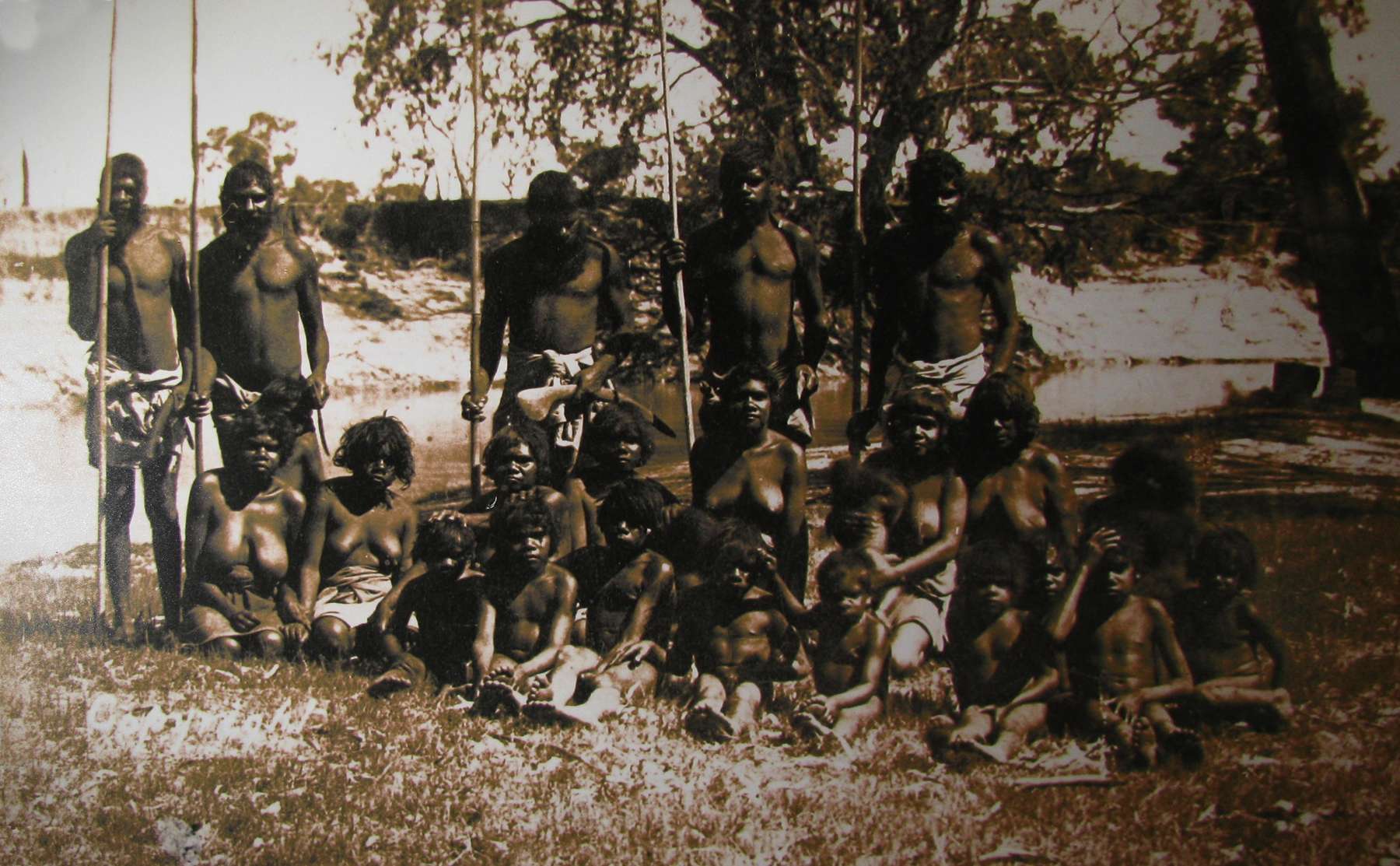
Here is a link to a clearer topic subject pic , no ghosting on r/h side of pic.
I am still chasing up some history of the pic and the tribe and other related pics. It is the Nanya Tribe who may be decendants of Mungo Man. Tribe is named after Harry Nanya who ppassed away in 1895. Harry is not in the pic. I am trying to chase up some info that there are more pics of the hairy person around and that there was two hairy persons associated in some way with the Nanya tribe . I will post more info if/when I have it.
Cheers
http://www.donsmaps.com/images12/familyIMG_2479.jpg
I am still chasing up some history of the pic and the tribe and other related pics. It is the Nanya Tribe who may be decendants of Mungo Man. Tribe is named after Harry Nanya who ppassed away in 1895. Harry is not in the pic. I am trying to chase up some info that there are more pics of the hairy person around and that there was two hairy persons associated in some way with the Nanya tribe . I will post more info if/when I have it.
Cheers
http://www.donsmaps.com/images12/familyIMG_2479.jpg
-
paulmcleod67
Re: WARNING TO ABORIGINAL PERSONS pics of decesed persons in
Hey Paul
Schools in Chile teach that their ancestors came from Australia.
https://www.google.com.au/search?q=chil ... e&ie=UTF-8[/quote]
Makes sense to me.
I'm a firm believer in gradual and ongoing continental drift over large periods of geological time.
However I also feel that sudden and rapid crustal displacement can occur if the right mechanical conditions of force and torque are encounterd.
Charles Hapgood proposed ice build up as the mechanical inertia source and sighted thousands of smashed together and flash frozen
saber tooth tigers alongside thousands of Woolly mammoths (still with undigested food in their stomachs) buried with tropical vegetation in the frozen Siberian Tundra .
My theory introduces an asteroid or comet with large mass entering the earths atmosphere a very low trajectory and striking, what became
lake Victoria in Africa.
The impact propogation wave traveling through the earths mantel and core may have been enough to split the African, Antarctic , Pacific and Nasca continental plates apart very rapidly and causing Australia, South America and Africa to move away from the (then) unfrozen continent of Antartica.
Take a look at the "official" geological age noted on continental plates specifically at subduction points were the pacific plate collides with the Antarctic plate, the African plate and the Nasca plate.
Dated at points to a conservative estimate of only one million years.
The crustal striation patterns in certain areas at these bounderies look pretty new and pretty rapidly formed.
Combine that with an anomalous and massive radial crack in the crust of the Pacific plate, on the directly opposite side
of the globe at Lake Victoria in Africa and there is enough to at least theories that around one million years ago Australia, Africa and South America may have been ridiculously close together.
Homo sapiens are estimated to have emerged 200,000 years ago. My research suggest a much longer history of modern humans than the current dating.
Where's the evidence for an older Homo sapiens then?
Destroyed by impacts and plate subduction over extreme time not to mention massive sea rises and unimaginable, tsunami's that may have been the basis of global flood legends worldwide. Australia's overall geological state speaks volumes for a continent wide, catastophic tsunami that washed in from the Oceans off W.A and flowed out through the great Australian bite and even low laying parts of QLD.
Ancient maps of Antartica's continental shelf drawn accurately and ice free bespeak this catastrophe.
Lake Victoria in Africa shows signs of shocked quartz (an indicator of extraterrestrial impact or volcanic explosion) and is being investigated currently by geologists looking at how it was formed.
Time and science will prove or disprove or disprove my theory.
If proven?
Well ,the Wallace line argument for Australia having no archaic primates will be circumvented by allowing migration from Africa into Antarctica and on to Australia, prior to the impact and roughly around the same time frame that Marsupials arrived here.
Aboriginal legends state that archaic primate hominids were here before they (Aboriginal peoples) arrived over sixty thousand years ago.
I tend pay close attention to oral traditions and compare them to the party game Chinese whispers, were you line up a group of people and whisper a statement to the first then have them pass that info to the next person and on down the line. After twenty people the final message will not match the original.
I'll have a few more global graphics done soon and will drop them in here.
Cheers mate
Schools in Chile teach that their ancestors came from Australia.
https://www.google.com.au/search?q=chil ... e&ie=UTF-8[/quote]
Makes sense to me.
I'm a firm believer in gradual and ongoing continental drift over large periods of geological time.
However I also feel that sudden and rapid crustal displacement can occur if the right mechanical conditions of force and torque are encounterd.
Charles Hapgood proposed ice build up as the mechanical inertia source and sighted thousands of smashed together and flash frozen
saber tooth tigers alongside thousands of Woolly mammoths (still with undigested food in their stomachs) buried with tropical vegetation in the frozen Siberian Tundra .
My theory introduces an asteroid or comet with large mass entering the earths atmosphere a very low trajectory and striking, what became
lake Victoria in Africa.
The impact propogation wave traveling through the earths mantel and core may have been enough to split the African, Antarctic , Pacific and Nasca continental plates apart very rapidly and causing Australia, South America and Africa to move away from the (then) unfrozen continent of Antartica.
Take a look at the "official" geological age noted on continental plates specifically at subduction points were the pacific plate collides with the Antarctic plate, the African plate and the Nasca plate.
Dated at points to a conservative estimate of only one million years.
The crustal striation patterns in certain areas at these bounderies look pretty new and pretty rapidly formed.
Combine that with an anomalous and massive radial crack in the crust of the Pacific plate, on the directly opposite side
of the globe at Lake Victoria in Africa and there is enough to at least theories that around one million years ago Australia, Africa and South America may have been ridiculously close together.
Homo sapiens are estimated to have emerged 200,000 years ago. My research suggest a much longer history of modern humans than the current dating.
Where's the evidence for an older Homo sapiens then?
Destroyed by impacts and plate subduction over extreme time not to mention massive sea rises and unimaginable, tsunami's that may have been the basis of global flood legends worldwide. Australia's overall geological state speaks volumes for a continent wide, catastophic tsunami that washed in from the Oceans off W.A and flowed out through the great Australian bite and even low laying parts of QLD.
Ancient maps of Antartica's continental shelf drawn accurately and ice free bespeak this catastrophe.
Lake Victoria in Africa shows signs of shocked quartz (an indicator of extraterrestrial impact or volcanic explosion) and is being investigated currently by geologists looking at how it was formed.
Time and science will prove or disprove or disprove my theory.
If proven?
Well ,the Wallace line argument for Australia having no archaic primates will be circumvented by allowing migration from Africa into Antarctica and on to Australia, prior to the impact and roughly around the same time frame that Marsupials arrived here.
Aboriginal legends state that archaic primate hominids were here before they (Aboriginal peoples) arrived over sixty thousand years ago.
I tend pay close attention to oral traditions and compare them to the party game Chinese whispers, were you line up a group of people and whisper a statement to the first then have them pass that info to the next person and on down the line. After twenty people the final message will not match the original.
I'll have a few more global graphics done soon and will drop them in here.
Cheers mate
You do not have the required permissions to view the files attached to this post.
-
TheBlackStump
- Gold Status - Frequent Poster
- Posts: 360
- Joined: Sat May 07, 2016 7:58 am
Re: WARNING TO ABORIGINAL PERSONS pics of decesed persons in
Hey Paul
My way of thinking is that we do not know what evidence of our ancestors on the planet exists under the oceans and also under the ice of the Arctic and Antarctic. Or even deep under the earth.
So without the opportunity to know exactly what life previously existed which is now under the oceans/earth and/or ice we can not discount that the big picture re our ancestors and hairy persons may be entirely different to the various theories that currently exist. These unkown pieces of the puzzle , if known , could show that our ancestors/hairy persons may have actually originated from the Arctic or Antarctic land masses or maybe even as far back as Patagonia as another example.
Just my 2 cents worth anyway.
Cheers
My way of thinking is that we do not know what evidence of our ancestors on the planet exists under the oceans and also under the ice of the Arctic and Antarctic. Or even deep under the earth.
So without the opportunity to know exactly what life previously existed which is now under the oceans/earth and/or ice we can not discount that the big picture re our ancestors and hairy persons may be entirely different to the various theories that currently exist. These unkown pieces of the puzzle , if known , could show that our ancestors/hairy persons may have actually originated from the Arctic or Antarctic land masses or maybe even as far back as Patagonia as another example.
Just my 2 cents worth anyway.
Cheers
-
paulmcleod67
Re: WARNING TO ABORIGINAL PERSONS pics of decesed persons in
Hi mate.TheBlackStump wrote:Hey Paul
My way of thinking is that we do not know what evidence of our ancestors on the planet exists under the oceans and also under the ice of the Arctic and Antarctic. Or even deep under the earth.
So without the opportunity to know exactly what life previously existed which is now under the oceans/earth and/or ice we can not discount that the big picture re our ancestors and hairy persons may be entirely different to the various theories that currently exist. These unkown pieces of the puzzle , if known , could show that our ancestors/hairy persons may have actually originated from the Arctic or Antarctic land masses or maybe even as far back as Patagonia as another example.
Just my 2 cents worth anyway.
Cheers
Here is a conundrum that has always bothered me and so far I have read nothing good that illuminates the problem...except for catastrophic change.
A Lost ancient Indonesian culture constructed "Gundam Panang" a multi-staged and quite massive pyramid complex, built out of thousands of polygonal
blocks of granite, of which there is no known quarry source for the stone monoliths anywhere near the site.
The only known comparative ancient site built with almost identical construction methods and materials is Nan Madol on the island of Pohnpei in Micronesia, thousands of miles away. I'm convinced by the architectural style that it was built by the same culture as those that built Gundang Padang, and judging by the site orientation of Nan Madol it was an outlaying fortified port on the outer limits of a lost (what had to have been an) empire.
(See image comparisons of the ruins and the distance from each other)
Now, given they are built by the same culture and that they were spread from Indonesia all the way into Micronesia in empire...
Why is there no evidence (of substance) of these amazing engineers and empire builders even found in such a close location as (say) King sound in W.A
which nowadays "uncle Bob" could sail across with his only his dog and his niece?
Our country is massive, the coasts are fertile, abundant with life and full of mineral resources...and not so far away from Gundang Pang it'self.
On the other hand the half sunken ruins of Nan Madol are almost a navigational world away.
I'm really starting to see (at least at a logical level) that an ancient and very real catastrophe of almost unimaginable scale must have struck the
coast of W.A . Then I looked at some of the latest science NASA is performing in modeling asteroid impacts of varying scale on land and sea.
After listening to Graham Hancock speaking on the Joe Rogan podcast, along with a geologist college (Randall Carlston), the astounding scale
that these random natural catastrophes can attain blew my mind.
I then went back to my pet theory on the possible Lake Victoria impact in Africa and it all began to make global sense.
Check this out...
You do not have the required permissions to view the files attached to this post.
-
paulmcleod67
Re: WARNING TO ABORIGINAL PERSONS pics of decesed persons in
I stumbled onto this weird Australian gov file as well as some NASA stuff on impact tsunami...
Ill never look at W.A geology the same either after listening to geologist Randall Carlston
Maybe these formations are not just simple dunes and parallel ridges...they might be fossilized water induced ripple ridges.
scars of a flood with 400 foot waves that swamped high ground and formed the now dried inland sea?
I'm just suggesting....
Ill never look at W.A geology the same either after listening to geologist Randall Carlston
Maybe these formations are not just simple dunes and parallel ridges...they might be fossilized water induced ripple ridges.
scars of a flood with 400 foot waves that swamped high ground and formed the now dried inland sea?
I'm just suggesting....
You do not have the required permissions to view the files attached to this post.