
LET ME EXPLAIN SOMETHING....MODUS OPERANDI
-
Scarts

- Gold Status - Frequent Poster
- Posts: 352
- Joined: Sat Aug 31, 2013 7:33 am
- Position: Researcher
Re: LET ME EXPLAIN SOMETHING....MODUS OPERANDI
So what you're saying Wolf, is getting into a huff and boycotting a forum because of something someone else said, is ridiculous and the sign of an immature ego? Subtlety isn't one of your strong points is it?
-
yowiedan
- Long Time Contributor
- Posts: 988
- Joined: Sat Feb 18, 2012 8:04 pm
- Position: Field Researcher
- Location: Blue Mountains
- Contact:
Re: LET ME EXPLAIN SOMETHING....MODUS OPERANDI
I think people are MISSING the point of what this Forum is about. They are too busy just fighting with words on here and not doing the one thing we should all be doing just getting on with Researching this Creature that lives in the Australian Bush, The Australian Yowie. If you want to go and fight with words go and join the Donald Trump Roller Coaster. I really also would like to know how many of you Actually get off your ASS and go and and Research or do you just sit on your chair infront of your computer and Ramble on and Forget what this Forum is about.
If you've never hiked in thongs, you've never lived. 
-
Bobnottski
- Approved Member
- Posts: 12
- Joined: Thu Feb 11, 2016 7:52 am
Re: LET ME EXPLAIN SOMETHING....MODUS OPERANDI
With all the recent happenings on here I would have to agree! 
-
Scarts
- Gold Status - Frequent Poster
- Posts: 352
- Joined: Sat Aug 31, 2013 7:33 am
- Position: Researcher
Re: LET ME EXPLAIN SOMETHING....MODUS OPERANDI
It all depends on your definition of research, Yowiedan.
If you've been following this, you will have learned it is now possible to collate and analyse yowie reports, plot them accurately on a google map of the earth, and then analyse the actual locations with the help of google streetview, all without leaving your armchair. For that, I am grateful for Paul McLeod's input. You have to give credit where it is due.
Did anyone notice anything about where most reports are concentrated?
If you've been following this, you will have learned it is now possible to collate and analyse yowie reports, plot them accurately on a google map of the earth, and then analyse the actual locations with the help of google streetview, all without leaving your armchair. For that, I am grateful for Paul McLeod's input. You have to give credit where it is due.
Did anyone notice anything about where most reports are concentrated?
-
Scarts
- Gold Status - Frequent Poster
- Posts: 352
- Joined: Sat Aug 31, 2013 7:33 am
- Position: Researcher
Re: LET ME EXPLAIN SOMETHING....MODUS OPERANDI
What Paul has done in that regard, is really great work!
It could be improved with colour coding of the sightings according to year. For instance, most recent bright red to oldest being bright white. This adds a new dimension to the data, being Time. This would provide information on trends and possible patterns at a glance. All from the comfort of your armchair!
It could be improved with colour coding of the sightings according to year. For instance, most recent bright red to oldest being bright white. This adds a new dimension to the data, being Time. This would provide information on trends and possible patterns at a glance. All from the comfort of your armchair!
-
Simon M
- Long Time Contributor
- Posts: 900
- Joined: Sun Sep 11, 2016 1:36 am
- Position: Unsure
- Location: Mostly at home
Re: LET ME EXPLAIN SOMETHING....MODUS OPERANDI
The latter.yowiedan wrote: I really also would like to know how many of you Actually get off your ASS and go and and Research or do you just sit on your chair infront of your computer and Ramble on...
I'm not a researcher and could never claim to be; I'm an armchair cryptozoology fanboy and always have been. I wouldn't know how to track an animal unless it wore a high-vis vest and a GPS tracker. Even then, I'd need a compass and a dowsing rod....and some help from someone who knows what they're doing.
That doesn't prevent me from making observations, however, and it doesn't mean those observations are always correct or incorrect. They're observations, and based on how little we know about these things a lot of what's discussed here is speculative.
If I tried to track a Yowie I'd probably end up accidentally discovering a hidden dope plantation and being killed by drug dealers or something ridiculous like that. Either that or I'd be one of those sad souls who gets lost for three days and survives by licking the dew from leaves and eating an out-of-date Mars bar they've found in their pocket.
A man's got to know his limitations - and I'm not going out into the bush. It would only end in tears (mine) and embarrassment (the SES guys who'd have to chopper me out of a ravine).
-
paulmcleod67
Re: LET ME EXPLAIN SOMETHING....MODUS OPERANDI
For those contending that the tee breaks at River road were caused by " OBVIOUS" storm damage, let me reply with these...
And Ill add that I was in the immediate area from Mid January 2017.
Never dismiss a claim offhand, it is annoying.
Cheers
And Ill add that I was in the immediate area from Mid January 2017.
Never dismiss a claim offhand, it is annoying.
Cheers
You do not have the required permissions to view the files attached to this post.
-
paulmcleod67
Re: LET ME EXPLAIN SOMETHING....MODUS OPERANDI
Rainfall statistics during this period vs the average and wettest day
Ipswich rainfall history (27.6146°S, 152.7609°E, 11m AMSL)
Wettest This Year 69.4mm 16/01/2017
Wettest This Month 1.0mm 09/02/2017
Driest This Year 0.0mm 01/01/2017
Driest This Month 0.0mm 01/02/2017
Total To February 180.8mm 11.0 days
Total This Month 1.0mm 1.0 days
YTD Average Rainfall 238.7mm 22.2 days
Long Term Average 122.1mm 11.6 days
Wettest February 434.9mm 2006
Wettest day:
16/01/2017
69.4mm
Ipswich rainfall history (27.6146°S, 152.7609°E, 11m AMSL)
Wettest This Year 69.4mm 16/01/2017
Wettest This Month 1.0mm 09/02/2017
Driest This Year 0.0mm 01/01/2017
Driest This Month 0.0mm 01/02/2017
Total To February 180.8mm 11.0 days
Total This Month 1.0mm 1.0 days
YTD Average Rainfall 238.7mm 22.2 days
Long Term Average 122.1mm 11.6 days
Wettest February 434.9mm 2006
Wettest day:
16/01/2017
69.4mm
-
Wolf
- Long Time Contributor
- Posts: 1572
- Joined: Thu Feb 04, 2016 10:46 pm
- Position: Artist
- Facebook Profile Page: https://www.facebook.com/groups/266070257413290/
- Contact:
Re: LET ME EXPLAIN SOMETHING....MODUS OPERANDI
Pretty muchScarts wrote:So what you're saying Wolf, is getting into a huff and boycotting a forum because of something someone else said, is ridiculous and the sign of an immature ego? Subtlety isn't one of your strong points is it?

I could add, childish, overly sensitive and unmanly but heaven forbid... someone might be offended

In saying that I understand why people DO take offence at other's words. I merely am trying to remind everyone of it being unnecessary. They are just words.
Today's world of Political Correctness, 'Safe Zones', triggering etc etc is literally insane, especially in Australia... the land of name-calling, sarcasm and jest. We are supposed to be a nation of tough, hard-arses who can laugh at ourselves aren't we? Why bother being subtle? I would appreciate it if someone reminded me of this fact if I ever found myself feeling 'offended' because of what someone on a forum said.
Whatever happened to 'Sticks and stones may break my bones but words can never hurt me.'
The mightiest oak was once a nut that stood his ground https://www.sasquatchstories.com
-
Rastus
- Bronze Status
- Posts: 98
- Joined: Fri Feb 20, 2009 8:37 am
- Position: Believer
Re: LET ME EXPLAIN SOMETHING....MODUS OPERANDI
paulmcleod67 wrote:Rainfall statistics during this period vs the average and wettest day
Ipswich rainfall history (27.6146°S, 152.7609°E, 11m AMSL)
Wettest This Year 69.4mm 16/01/2017
Wettest This Month 1.0mm 09/02/2017
Driest This Year 0.0mm 01/01/2017
Driest This Month 0.0mm 01/02/2017
Total To February 180.8mm 11.0 days
Total This Month 1.0mm 1.0 days
YTD Average Rainfall 238.7mm 22.2 days
Long Term Average 122.1mm 11.6 days
Wettest February 434.9mm 2006
Wettest day:
16/01/2017
69.4mm
Storms do not always consist of large amounts of rain and tree branches dont require said rainfall to be damaged, just wind and weak points through either natural growth or stress related defects or from biological causes. The pictures you have posted look nothing more than wind damage and these sorts of scenes occur on a regular basis Australia wide. I really dont think yowies are climbing up some of those larger trees to snap branches. Nice effort though , keep up the good work.
-
paulmcleod67
Re: LET ME EXPLAIN SOMETHING....MODUS OPERANDI
Just want to jot down that today I found a left and right footprint that would make the Hulk proud, along with a new tree break. All on video, here are some pix of the video footage.
Cheers
Cheers
You do not have the required permissions to view the files attached to this post.
-
paulmcleod67
Re: LET ME EXPLAIN SOMETHING....MODUS OPERANDI
Opposing foot and new break...
You do not have the required permissions to view the files attached to this post.
-
Simon M
- Long Time Contributor
- Posts: 900
- Joined: Sun Sep 11, 2016 1:36 am
- Position: Unsure
- Location: Mostly at home
Re: LET ME EXPLAIN SOMETHING....MODUS OPERANDI
That footprint is massive. When you look at the tree branch breakages in the context of the footprints being present, the broken branches do seem more than coincidental.
-
Wolf
- Long Time Contributor
- Posts: 1572
- Joined: Thu Feb 04, 2016 10:46 pm
- Position: Artist
- Facebook Profile Page: https://www.facebook.com/groups/266070257413290/
- Contact:
Re: LET ME EXPLAIN SOMETHING....MODUS OPERANDI
Sorry mate, but to me that looks like an echidna has been digging, or possibly a bandicoot.paulmcleod67 wrote:Just want to jot down that today I found a left and right footprint that would make the Hulk proud, along with a new tree break. All on video, here are some pix of the video footage.
Cheers
Of course, pictures can be deceiving and I wasn't there.
The mightiest oak was once a nut that stood his ground https://www.sasquatchstories.com
-
paulmcleod67
Re: LET ME EXPLAIN SOMETHING....MODUS OPERANDI
Its a mid tarsal break showing in the middle and even toe marks from kickout.Wolf wrote:Sorry mate, but to me that looks like an echidna has been digging, or possibly a bandicoot.paulmcleod67 wrote:Just want to jot down that today I found a left and right footprint that would make the Hulk proud, along with a new tree break. All on video, here are some pix of the video footage.
Cheers
Of course, pictures can be deceiving and I wasn't there.
I know what echidna digs look like matey I was in the army for 12 years and seen plenty in the bush.
I get that you don't believe a word I say Wolf and that,s fine mate. Like I keep saying come and take a look for yourself?
I certainly have better things to do with my time than to move interstate in order to perpetrate a hoax.....for what reason?
My wife would have killed me for dragging her here just to fake stuff to post here and on youtube.
And to clarify something. I didn't entertain stopping posting here because I was offended by remarks, I was going to stop posting here because a lot of the comments concerning some of my topical discussions were sarcastically phrased remarks that I just didn't and don't have time to deal with, because I'm busy.
Like I said I'm doing this resaserch full time here now and, writting this I can think of two dozen research items I could be doing instead of this reply
But you are entitled to your opinions and good luck to you mate.
Cheers
-
Simon M
- Long Time Contributor
- Posts: 900
- Joined: Sun Sep 11, 2016 1:36 am
- Position: Unsure
- Location: Mostly at home
Re: LET ME EXPLAIN SOMETHING....MODUS OPERANDI
I think Paul's work has merit. I'm intrigued by what he's doing and would like to see more.
I'm still not 100% sure these things are apes - they may look ape-like as a result of convergent evolution (just a theory I have), but they also seem to have characteristics that aren't simian or human. I suspect their ancestors diverged from apes a very long time ago, much further back than we might expect.
I think they've developed bipedalism completely independently of homo sapiens, which is why they walk so differently and have such a noticeably different physiology. I'm not sure they're closely related to us or the other great apes (again, just a theory). I think this may be why DNA results derived from hair samples are always 'inconclusive'. The evidence suggests they're mammals, obviously, but beyond that I think they're genetically very different from anything else still alive today.
I'm still not 100% sure these things are apes - they may look ape-like as a result of convergent evolution (just a theory I have), but they also seem to have characteristics that aren't simian or human. I suspect their ancestors diverged from apes a very long time ago, much further back than we might expect.
I think they've developed bipedalism completely independently of homo sapiens, which is why they walk so differently and have such a noticeably different physiology. I'm not sure they're closely related to us or the other great apes (again, just a theory). I think this may be why DNA results derived from hair samples are always 'inconclusive'. The evidence suggests they're mammals, obviously, but beyond that I think they're genetically very different from anything else still alive today.
-
paulmcleod67
Re: LET ME EXPLAIN SOMETHING....MODUS OPERANDI
Interesting comments and observations mate. There is another less well known theory that might have something to it, and that is, that these are upright marsupial bipeds?Simon M wrote:I think Paul's work has merit. I'm intrigued by what he's doing and would like to see more.
I'm still not 100% sure these things are apes - they may look ape-like as a result of convergent evolution (just a theory I have), but they also seem to have characteristics that aren't simian or human. I suspect their ancestors diverged from apes a very long time ago, much further back than we might expect.
I think they've developed bipedalism completely independently of homo sapiens, which is why they walk so differently and have such a noticeably different physiology. I'm not sure they're closely related to us or the other great apes (again, just a theory). I think this may be why DNA results derived from hair samples are always 'inconclusive'. The evidence suggests they're mammals, obviously, but beyond that I think they're genetically very different from anything else still alive today.
I can see no reason why evolution in Australia's natural history of isolation would not branch towards a bipedal species? A common example of such a direction can be seen in kangaroos ( a long way from bipedal but I'm sure you catch my drift).
There is a good debate between a librarian archive researchers theory (cant recall his name but will find and link it later) of the yowie being just such a marsupial bipedal species followed by a well considered rebuttal by an authority, the author then presents a rebuttal of the rebuttal, making for an interesting argument each backed with it's own merits.
So there is a least a remote and suggestive notion of independent evolution which might account for the land bridge problem....but I dont know?
FOUND A CACHED VERSION HERE....
http://webcache.googleusercontent.com/s ... clnk&gl=au
Anyone here looked into this in more detail?
Cheers
-
paulmcleod67
Re: LET ME EXPLAIN SOMETHING....MODUS OPERANDI
Here is an ABC story on the above mentioned Marsupial biped theory....
http://www.abc.net.au/radionational/pro ... em/3409644
http://www.abc.net.au/radionational/pro ... em/3409644
-
paulmcleod67
Re: LET ME EXPLAIN SOMETHING....MODUS OPERANDI
ABC program transcript of marsupial yowie theory by G .JOYNER 2003
http://www.abc.net.au/radionational/pro ... em/3409644
The 'Australia Gorilla': An Insoluble Problem
show transcript
Sunday 28 December 2003 8:45AM
Did the 'Australian Gorilla' really exist? Throughout much of the 19th century there were reports of some unknown animal called the 'Australian Gorilla' or 'Yahoo'. These reports were largely ignored by the scientists of the day. Retired public servant and historian Graham Joyner from Canberra takes another look at the story and comes up with some interesting ideas.
Transcript
Hide
Robyn Williams: This is Ockham's Razor Number 997. It's about a myth, a figment of the imagination, a wild fancy. Or is it? How many times has something as fanciful as a unicorn, a yeti, a mermaid or a werewolf turned out to be based on fact?
Here's Canberra historian Graham Joyner, with his view of the unlikely.
Graham Joyner: Throughout much of the 19th century, reports of some unknown animal called the 'Australian gorilla' or 'yahoo' regularly emerged from the south-east corner of Australia, but were largely ignored by scientists of the day. On the two occasions when the existence of the animal did become the object of scientific attention, the real issues were marginalised.
In recent years the matter has been subjected to renewed debate, yet it is still poorly understood. Indeed, some years ago an academic acquaintance of mine with an interest in the matter told me of a revealing remark made to him by a scientist at The Australian Museum. The remark to my friend was along the lines that 'Surely you at least understand that there have never been gorillas in Australia.'
Now it would be impossible to quarrel with this point of view. Australia is a land of marsupials while the gorilla is a placental animal which, except for a few in zoos, is found only in Africa. And similarly for the other large apes. Yet, paradoxically, I am going to suggest we might reasonably entertain the hypothesis that there have been 'Australian gorillas'. How is this possible?
Another, more famous, paradox may throw light on this one. Since its introduction to Europeans in the late 18th century, the platypus has been an almost endless source of wonder. Umberto Eco, Professor of Semiotics at Bologna, has recently brought together various theoretical considerations to explain the amazement generated in scientific circles by this strange animal. In his book 'Kant and the Platypus', Eco asks what would Kant have made of the platypus?, although Eco might have chosen any number of other Australian animals to make his point.
Kant was, of course, the 18th century German philosopher who would never have seen a platypus but who gave us what he called a 'Copernican revolution' in our conventional view of the world, whereby the world conforms to the mind rather than the mind being merely receptive to the world.
As part of this transcendental approach, Kant introduced a number of so-called categories of the understanding, but also saw the need for what he called the schema, a notion intermediate between the categories and the object perceived. The schema is supposed to permit the formation of the object perceived in the mind. Without it, Kant believed, objects could not be comprehended by the mind at all.
In talking about Kant and the platypus, Eco is leading up to a more general question: how do we construct the schema of an object which was previously completely unknown to us? Or, more simply, how do you conceptualise something totally new? Whatever the answer in terms of critical philosophy, it is clear that we often react to an unknown phenomenon by seeking that scrap of content in our minds that seems to account for the new fact. In other words, the unknown is often seen in terms of the known.
Apart from the platypus, Eco gives two examples of this process. The first concerns Marco Polo and the rhinoceros. It seems that Polo had never seen the rhinoceros but already possessed the notion of the unicorn. He therefore decided that the rhinoceros must be that fabulous beast, although a strange example of the species in being large and black rather than slender and white. Eco also speculates on what Montezuma might have made of reports about the conquistadors' horses, which his Aztec informants had perceived to be large deer.
Another example of this peculiar form of blindness comes from astronomy. In 1610 Galileo announced that he observed the planet Saturn in triplet form. He thought that two smaller bodies, or 'stars', accompanied the planet on either side (although on a later occasion these had inexplicably vanished). It seems that Galileo lacked the ability to conceptualise planetary rings, which were not identified as such for almost half a century.
These and many examples like them support the theory that discovery, even the discovery of discrete objects by direct observation, can often be a complex and protracted process. More significantly they suggest that the mind can impose a pattern on the world and that empiricism, the doctrine that what we perceive corresponds to the external world, doesn't always work.
Taking all this into account, let us now try to imagine the real possibility that some large animal continued to exist, unknown to science, in areas of south-east Australia up to the beginning of the 20th century. How would it have first appeared to early European visitors and what might the Aborigines have had to say about it?
It is probable that any such large animal, seen only briefly and intermittently by European settlers on the fringes of society would, in the manner discussed, have been identified with something already present in the minds of its observers. And if it stood upright on two legs or climbed trees, what more suitable model than one of the better known apes, either the orang-utan or, from the 1860s onwards, the gorilla?
And here we have resolved the paradox mentioned earlier. There could be no gorillas in Australia but it was quite possible for an 'Australian gorilla', whatever that might be, to make an appearance. This expression was, after all, just a name, though one which, without the simultaneous appearance of the creature itself, was sure to be misunderstood.
Similarly, someone knowing nothing of the Tasmanian tiger might object that such an animal could not exist because there were no tigers in Tasmania.
Incidentally, use of the orang-utan as a model for the 'Australian gorilla' is particularly interesting. The Adult orang-utan may first have been seen in England around the end of the 18th century. By the early 19th century there is documentary evidence that this animal, or something very like it, was being exhibited in English menageries under the name 'yahoo', the brutish creature invented by Dean Swift in Gulliver's Travels. This could well account for the appearance of the name 'yahoo' in Australia from the 1830s onwards to describe the creature later called the 'Australian gorilla'.
Names sit uneasily upon objects they represent. In cases of something totally new, a name may be borrowed from a conventional form but, unless naming is matched with perception, there is nothing to link the one with the other. Later, if the name was always obscure and if the animal no longer appears in our visual frame of reference, the entire concept, both name and object, may become problematic. Such at least was the fate of the name 'yahoo' and the unknown creature to which it referred.
A further difficulty arises where more than one language is involved. Different languages can categorise the world in different ways so that it is not always possible to match a word in one language with that in another. For example, it seems that the French word 'jaune' does not correspond exactly to the English 'yellow'. And the Greek 'logos' is famously of wider application than the English 'word'.
In the case of the so-called 'Australian gorilla', linguistic and cultural differences between Europeans and the Aborigines would have represented an almost insurmountable barrier to understanding. No linguistic representation of the concept by the Aborigines could be expected to fit readily into the categories employed by European minds.
However, there are indications that the Aboriginal word 'dulugal' from the Dharawahal and Dhurga languages represents, among other concepts, the animal referred to as the 'Australian gorilla'. Not surprisingly perhaps, linguists have made rather a mess of this identification and their efforts are further hampered by the fact that the standard treatment of 'dulugal' relies on relatively recent oral sources while managing to overlook every relevant historical citation.
Returning to the attitude of science, someone who ought to have known better once suggested to me that acknowledgement of the possible of an 'Australian gorilla' is rather like belief in the existence of God. But right at the heart of the present matter lies a series of what are supposed to be observations.
In other words, we are dealing not with metaphysics but with data of an empirical nature, which may be true or false, but the truth of which can be determined by scientific means. In fact evidence for the 'Australian gorilla' is based on testing of observations using a correlative method.
This involves comparison of physical characteristics, such as shape, distinctive markings, dual gait, possession of nails or claws and tree climbing ability, from descriptions given in independent accounts. An actual example of this process follows shortly.
Meanwhile, another reason for the indifference of zoologists then as now, lies in a peculiarity of zoological method. That is, zoologists normally require a body.
The most famous example of this is a fictional one. At the climax of Arthur Conan Doyle's novel 'The Lost World' the central character presents a sceptical audience with various pieces of evidence for the continued existence of prehistoric life on an isolated South American plateau, but all are rejected. He then asks, 'You would require to see the thing itself?' and is told, 'Undoubtedly'. Whereupon a pterodactyl is released from a packing case and pandemonium ensues.
This doctrine of the primacy of the physical specimen is still a matter of faith among zoologists. The former Director of the Australian Museum has written of another disputed entity: 'Once physical evidence is found (by this I mean a body...) then the issue would gain some standing.'
So there it is. Nothing but the animal itself will do. There are, however, a number of problems with this all or nothing approach. First, it is without any basis in empirical theory. Next, there is no equivalent demand in other branches of science, such as physics or astronomy. Again, it makes nonsense of the concept of evidence, since to demand the thing itself means that no evidence at all may be admitted. Finally, it is not in accord with what actually happens in many cases of discovery, which often follow a broken, meandering path where the object itself is only gradually revealed.
Perhaps as a consequence of their preoccupation with specimens, zoologists can often be found explaining away awkward pieces of information, while avoiding all linguistic and philosophical issues and misdirecting anything with an indigenous content to a box labelled 'Aboriginal myth'.
In conclusion, let us consider the following vignette from the last occasion on which the case of the 'Australian gorilla' came under scientific scrutiny.
In October 1912 the poet and cattle farmer, Sydney Wheeler Jephcott found some tracks near Bombala which he believed to be those of an unknown animal. The print of the fore foot resembled, but differed from, that of a human hand. Jephcott made casts of the tracks, which he sent with a covering note to Edgeworth David, then Professor of Geology at Sydney University. David, after the examining the casts, pronounced them fakes.
It is easy to imagine the scene. David, who is always being sent unusual objects to identify, reads Jephcott's letter then picks up one of the casts. The eminent geologist frowns as he ponder the object before him. After a while he smiles and shakes his head. It is only a human hand after all. The prints have been manufactured by some third party.
David's examination, cursory as it was, invoked the following defence from a contemporary naturalist. Science is really enlightenment, he explained, it is never dogmatic. It is merely a question of evidence. Produce contrary evidence and science will modify its view accordingly.
The trouble with this idealistic view of science is that, for various reasons, it is not true. As is well known, established theories are seldom challenged by contrary evidence until a competing theory has overwhelming support. More to the point, evidence may also be overlooked because confrontation with novelty can compel the mind to search for an image with which it is already familiar.
And this is what evidently happened here. After the manner of Galileo and the rings of Saturn, David lacked the concept of the 'Australian gorilla' and would have had to resort to construction of some conventional mental image to account for the unfamiliar object before him. And what better than the image of the human hand already provided by Jephcott?
In hindsight, this misconception might have been avoided. Unknown to both men, there existed a precedent which provided support for Jephcott's hypothesis. The unknown creature killed near Braidwood nearly 20 years earlier possessed fore feet described as 'shaped like a man's hands with the palm precisely similar and toes which had a close resemblance to fingers with overgrown nails'.
In other words, the only other detailed description of the 'Australian gorilla's fore feet neatly confirmed Jephcott's description of the cast that David had rejected.
As it is, David here represents not enlightenment, but enlightenment's antithesis: authority. His action exemplifies what the late Stephen Jay Gould, on his essay on the lynxes, aptly called 'the authoritarian form of the empiricist myth'. Perhaps the real enlightenment figure is Jephcott, who is seen as informed, determined, courageous and relatively unburdened by preconception.
Finally, I referred in the title of this talk to the matter as 'insoluble', not because there was no problem, or because no solution presented itself, but because there seems to be no will to solve it. It would be interesting to know whether that can change almost a century after the matter was last debated in public.
Robyn Williams: So, what would it take to convince you? Graham Joyner is a historian and, as you heard, something of a philosopher, and he lives in Canberra, where most yahoos are in Federal Parliament
http://www.abc.net.au/radionational/pro ... em/3409644
The 'Australia Gorilla': An Insoluble Problem
show transcript
Sunday 28 December 2003 8:45AM
Did the 'Australian Gorilla' really exist? Throughout much of the 19th century there were reports of some unknown animal called the 'Australian Gorilla' or 'Yahoo'. These reports were largely ignored by the scientists of the day. Retired public servant and historian Graham Joyner from Canberra takes another look at the story and comes up with some interesting ideas.
Transcript
Hide
Robyn Williams: This is Ockham's Razor Number 997. It's about a myth, a figment of the imagination, a wild fancy. Or is it? How many times has something as fanciful as a unicorn, a yeti, a mermaid or a werewolf turned out to be based on fact?
Here's Canberra historian Graham Joyner, with his view of the unlikely.
Graham Joyner: Throughout much of the 19th century, reports of some unknown animal called the 'Australian gorilla' or 'yahoo' regularly emerged from the south-east corner of Australia, but were largely ignored by scientists of the day. On the two occasions when the existence of the animal did become the object of scientific attention, the real issues were marginalised.
In recent years the matter has been subjected to renewed debate, yet it is still poorly understood. Indeed, some years ago an academic acquaintance of mine with an interest in the matter told me of a revealing remark made to him by a scientist at The Australian Museum. The remark to my friend was along the lines that 'Surely you at least understand that there have never been gorillas in Australia.'
Now it would be impossible to quarrel with this point of view. Australia is a land of marsupials while the gorilla is a placental animal which, except for a few in zoos, is found only in Africa. And similarly for the other large apes. Yet, paradoxically, I am going to suggest we might reasonably entertain the hypothesis that there have been 'Australian gorillas'. How is this possible?
Another, more famous, paradox may throw light on this one. Since its introduction to Europeans in the late 18th century, the platypus has been an almost endless source of wonder. Umberto Eco, Professor of Semiotics at Bologna, has recently brought together various theoretical considerations to explain the amazement generated in scientific circles by this strange animal. In his book 'Kant and the Platypus', Eco asks what would Kant have made of the platypus?, although Eco might have chosen any number of other Australian animals to make his point.
Kant was, of course, the 18th century German philosopher who would never have seen a platypus but who gave us what he called a 'Copernican revolution' in our conventional view of the world, whereby the world conforms to the mind rather than the mind being merely receptive to the world.
As part of this transcendental approach, Kant introduced a number of so-called categories of the understanding, but also saw the need for what he called the schema, a notion intermediate between the categories and the object perceived. The schema is supposed to permit the formation of the object perceived in the mind. Without it, Kant believed, objects could not be comprehended by the mind at all.
In talking about Kant and the platypus, Eco is leading up to a more general question: how do we construct the schema of an object which was previously completely unknown to us? Or, more simply, how do you conceptualise something totally new? Whatever the answer in terms of critical philosophy, it is clear that we often react to an unknown phenomenon by seeking that scrap of content in our minds that seems to account for the new fact. In other words, the unknown is often seen in terms of the known.
Apart from the platypus, Eco gives two examples of this process. The first concerns Marco Polo and the rhinoceros. It seems that Polo had never seen the rhinoceros but already possessed the notion of the unicorn. He therefore decided that the rhinoceros must be that fabulous beast, although a strange example of the species in being large and black rather than slender and white. Eco also speculates on what Montezuma might have made of reports about the conquistadors' horses, which his Aztec informants had perceived to be large deer.
Another example of this peculiar form of blindness comes from astronomy. In 1610 Galileo announced that he observed the planet Saturn in triplet form. He thought that two smaller bodies, or 'stars', accompanied the planet on either side (although on a later occasion these had inexplicably vanished). It seems that Galileo lacked the ability to conceptualise planetary rings, which were not identified as such for almost half a century.
These and many examples like them support the theory that discovery, even the discovery of discrete objects by direct observation, can often be a complex and protracted process. More significantly they suggest that the mind can impose a pattern on the world and that empiricism, the doctrine that what we perceive corresponds to the external world, doesn't always work.
Taking all this into account, let us now try to imagine the real possibility that some large animal continued to exist, unknown to science, in areas of south-east Australia up to the beginning of the 20th century. How would it have first appeared to early European visitors and what might the Aborigines have had to say about it?
It is probable that any such large animal, seen only briefly and intermittently by European settlers on the fringes of society would, in the manner discussed, have been identified with something already present in the minds of its observers. And if it stood upright on two legs or climbed trees, what more suitable model than one of the better known apes, either the orang-utan or, from the 1860s onwards, the gorilla?
And here we have resolved the paradox mentioned earlier. There could be no gorillas in Australia but it was quite possible for an 'Australian gorilla', whatever that might be, to make an appearance. This expression was, after all, just a name, though one which, without the simultaneous appearance of the creature itself, was sure to be misunderstood.
Similarly, someone knowing nothing of the Tasmanian tiger might object that such an animal could not exist because there were no tigers in Tasmania.
Incidentally, use of the orang-utan as a model for the 'Australian gorilla' is particularly interesting. The Adult orang-utan may first have been seen in England around the end of the 18th century. By the early 19th century there is documentary evidence that this animal, or something very like it, was being exhibited in English menageries under the name 'yahoo', the brutish creature invented by Dean Swift in Gulliver's Travels. This could well account for the appearance of the name 'yahoo' in Australia from the 1830s onwards to describe the creature later called the 'Australian gorilla'.
Names sit uneasily upon objects they represent. In cases of something totally new, a name may be borrowed from a conventional form but, unless naming is matched with perception, there is nothing to link the one with the other. Later, if the name was always obscure and if the animal no longer appears in our visual frame of reference, the entire concept, both name and object, may become problematic. Such at least was the fate of the name 'yahoo' and the unknown creature to which it referred.
A further difficulty arises where more than one language is involved. Different languages can categorise the world in different ways so that it is not always possible to match a word in one language with that in another. For example, it seems that the French word 'jaune' does not correspond exactly to the English 'yellow'. And the Greek 'logos' is famously of wider application than the English 'word'.
In the case of the so-called 'Australian gorilla', linguistic and cultural differences between Europeans and the Aborigines would have represented an almost insurmountable barrier to understanding. No linguistic representation of the concept by the Aborigines could be expected to fit readily into the categories employed by European minds.
However, there are indications that the Aboriginal word 'dulugal' from the Dharawahal and Dhurga languages represents, among other concepts, the animal referred to as the 'Australian gorilla'. Not surprisingly perhaps, linguists have made rather a mess of this identification and their efforts are further hampered by the fact that the standard treatment of 'dulugal' relies on relatively recent oral sources while managing to overlook every relevant historical citation.
Returning to the attitude of science, someone who ought to have known better once suggested to me that acknowledgement of the possible of an 'Australian gorilla' is rather like belief in the existence of God. But right at the heart of the present matter lies a series of what are supposed to be observations.
In other words, we are dealing not with metaphysics but with data of an empirical nature, which may be true or false, but the truth of which can be determined by scientific means. In fact evidence for the 'Australian gorilla' is based on testing of observations using a correlative method.
This involves comparison of physical characteristics, such as shape, distinctive markings, dual gait, possession of nails or claws and tree climbing ability, from descriptions given in independent accounts. An actual example of this process follows shortly.
Meanwhile, another reason for the indifference of zoologists then as now, lies in a peculiarity of zoological method. That is, zoologists normally require a body.
The most famous example of this is a fictional one. At the climax of Arthur Conan Doyle's novel 'The Lost World' the central character presents a sceptical audience with various pieces of evidence for the continued existence of prehistoric life on an isolated South American plateau, but all are rejected. He then asks, 'You would require to see the thing itself?' and is told, 'Undoubtedly'. Whereupon a pterodactyl is released from a packing case and pandemonium ensues.
This doctrine of the primacy of the physical specimen is still a matter of faith among zoologists. The former Director of the Australian Museum has written of another disputed entity: 'Once physical evidence is found (by this I mean a body...) then the issue would gain some standing.'
So there it is. Nothing but the animal itself will do. There are, however, a number of problems with this all or nothing approach. First, it is without any basis in empirical theory. Next, there is no equivalent demand in other branches of science, such as physics or astronomy. Again, it makes nonsense of the concept of evidence, since to demand the thing itself means that no evidence at all may be admitted. Finally, it is not in accord with what actually happens in many cases of discovery, which often follow a broken, meandering path where the object itself is only gradually revealed.
Perhaps as a consequence of their preoccupation with specimens, zoologists can often be found explaining away awkward pieces of information, while avoiding all linguistic and philosophical issues and misdirecting anything with an indigenous content to a box labelled 'Aboriginal myth'.
In conclusion, let us consider the following vignette from the last occasion on which the case of the 'Australian gorilla' came under scientific scrutiny.
In October 1912 the poet and cattle farmer, Sydney Wheeler Jephcott found some tracks near Bombala which he believed to be those of an unknown animal. The print of the fore foot resembled, but differed from, that of a human hand. Jephcott made casts of the tracks, which he sent with a covering note to Edgeworth David, then Professor of Geology at Sydney University. David, after the examining the casts, pronounced them fakes.
It is easy to imagine the scene. David, who is always being sent unusual objects to identify, reads Jephcott's letter then picks up one of the casts. The eminent geologist frowns as he ponder the object before him. After a while he smiles and shakes his head. It is only a human hand after all. The prints have been manufactured by some third party.
David's examination, cursory as it was, invoked the following defence from a contemporary naturalist. Science is really enlightenment, he explained, it is never dogmatic. It is merely a question of evidence. Produce contrary evidence and science will modify its view accordingly.
The trouble with this idealistic view of science is that, for various reasons, it is not true. As is well known, established theories are seldom challenged by contrary evidence until a competing theory has overwhelming support. More to the point, evidence may also be overlooked because confrontation with novelty can compel the mind to search for an image with which it is already familiar.
And this is what evidently happened here. After the manner of Galileo and the rings of Saturn, David lacked the concept of the 'Australian gorilla' and would have had to resort to construction of some conventional mental image to account for the unfamiliar object before him. And what better than the image of the human hand already provided by Jephcott?
In hindsight, this misconception might have been avoided. Unknown to both men, there existed a precedent which provided support for Jephcott's hypothesis. The unknown creature killed near Braidwood nearly 20 years earlier possessed fore feet described as 'shaped like a man's hands with the palm precisely similar and toes which had a close resemblance to fingers with overgrown nails'.
In other words, the only other detailed description of the 'Australian gorilla's fore feet neatly confirmed Jephcott's description of the cast that David had rejected.
As it is, David here represents not enlightenment, but enlightenment's antithesis: authority. His action exemplifies what the late Stephen Jay Gould, on his essay on the lynxes, aptly called 'the authoritarian form of the empiricist myth'. Perhaps the real enlightenment figure is Jephcott, who is seen as informed, determined, courageous and relatively unburdened by preconception.
Finally, I referred in the title of this talk to the matter as 'insoluble', not because there was no problem, or because no solution presented itself, but because there seems to be no will to solve it. It would be interesting to know whether that can change almost a century after the matter was last debated in public.
Robyn Williams: So, what would it take to convince you? Graham Joyner is a historian and, as you heard, something of a philosopher, and he lives in Canberra, where most yahoos are in Federal Parliament
-
paulmcleod67
Re: LET ME EXPLAIN SOMETHING....MODUS OPERANDI
And with that in mind I watched this clip again, this time considering the above,
writings and debate from 2003 and never (as far as I know,and could be wrong) brought up again?
https://youtu.be/T-wS9qQ_i60
And the original "shaky" clip in which I still belive I caught something other than wind and sticks.
https://youtu.be/kwwLLgLJOKs
I still don't know exactly whats going on near my home, but I,m grateful it seems to be an ongoing thing, time will tell.
Cheers
writings and debate from 2003 and never (as far as I know,and could be wrong) brought up again?
https://youtu.be/T-wS9qQ_i60
And the original "shaky" clip in which I still belive I caught something other than wind and sticks.
https://youtu.be/kwwLLgLJOKs
I still don't know exactly whats going on near my home, but I,m grateful it seems to be an ongoing thing, time will tell.
Cheers
-
Wolf
- Long Time Contributor
- Posts: 1572
- Joined: Thu Feb 04, 2016 10:46 pm
- Position: Artist
- Facebook Profile Page: https://www.facebook.com/groups/266070257413290/
- Contact:
Re: LET ME EXPLAIN SOMETHING....MODUS OPERANDI
Interesting stuff Paul and Simon.
Kudos Paul for not 'taking your ball and going home', keep up the researching. Even if your footage is only swinging branches and sticks, and the tree breaks ARE from the windy weather, does not mean the big fellas are not about where you're at. Like I mentioned elsewhere, with the current drought some of the only water for miles is in the Lockyer valley dams. Even the creek near me has dried up to one remaining puddle, and I'm on the Gold Coast with higher rainfall.
Kudos Paul for not 'taking your ball and going home', keep up the researching. Even if your footage is only swinging branches and sticks, and the tree breaks ARE from the windy weather, does not mean the big fellas are not about where you're at. Like I mentioned elsewhere, with the current drought some of the only water for miles is in the Lockyer valley dams. Even the creek near me has dried up to one remaining puddle, and I'm on the Gold Coast with higher rainfall.
The mightiest oak was once a nut that stood his ground https://www.sasquatchstories.com
-
Simon M
- Long Time Contributor
- Posts: 900
- Joined: Sun Sep 11, 2016 1:36 am
- Position: Unsure
- Location: Mostly at home
Re: LET ME EXPLAIN SOMETHING....MODUS OPERANDI
Those links are excellent, Paul.
The marsupial idea has merit, and makes sense. Plenty of examples of convergent evolution exist in Australia where marsupials fill the ecological niche filled by placental mammals elsewhere.
The marsupial idea has merit, and makes sense. Plenty of examples of convergent evolution exist in Australia where marsupials fill the ecological niche filled by placental mammals elsewhere.
-
Wolf
- Long Time Contributor
- Posts: 1572
- Joined: Thu Feb 04, 2016 10:46 pm
- Position: Artist
- Facebook Profile Page: https://www.facebook.com/groups/266070257413290/
- Contact:
Re: LET ME EXPLAIN SOMETHING....MODUS OPERANDI
Yes, but this would mean our Yowies are not related in any way to Sasquatch, Yerin, Yeti, etc.Simon M wrote:Those links are excellent, Paul.
The marsupial idea has merit, and makes sense. Plenty of examples of convergent evolution exist in Australia where marsupials fill the ecological niche filled by placental mammals elsewhere.
Are all these animals from different genuses?
'Science' has a hard enough time accepting a surviving relative of us, let alone so many convergent evolutionary paths.
But then look at the Dogman... an apparently living example of convergence.
The mightiest oak was once a nut that stood his ground https://www.sasquatchstories.com
-
Wolf
- Long Time Contributor
- Posts: 1572
- Joined: Thu Feb 04, 2016 10:46 pm
- Position: Artist
- Facebook Profile Page: https://www.facebook.com/groups/266070257413290/
- Contact:
Re: LET ME EXPLAIN SOMETHING....MODUS OPERANDI
A Yowie carrying young in a pouch... that'd be a sight
The mightiest oak was once a nut that stood his ground https://www.sasquatchstories.com
-
Simon M
- Long Time Contributor
- Posts: 900
- Joined: Sun Sep 11, 2016 1:36 am
- Position: Unsure
- Location: Mostly at home
Re: LET ME EXPLAIN SOMETHING....MODUS OPERANDI
It's possible that the Yowie, Sasquatch (and so forth) are all related to each other and have existed since the era when most of the Earth's continents were joined by so-called 'land bridges'. They could still all be of the same genus, but one so ancient they're not related to anything else still alive today.Wolf wrote:Yes, but this would mean our Yowies are not related in any way to Sasquatch, Yerin, Yeti, etc.
Are all these animals from different genuses?
'Science' has a hard enough time accepting a surviving relative of us, let alone so many convergent evolutionary paths.
-
deadpool

- Long Time Contributor
- Posts: 527
- Joined: Thu Sep 11, 2008 9:09 am
- Position: Researcher
- Location: South-East QLD
- Contact:
Re: LET ME EXPLAIN SOMETHING....MODUS OPERANDI
Simon M wrote:It's possible that the Yowie, Sasquatch (and so forth) are all related to each other and have existed since the era when most of the Earth's continents were joined by so-called 'land bridges'. They could still all be of the same genus, but one so ancient they're not related to anything else still alive today.Wolf wrote:Yes, but this would mean our Yowies are not related in any way to Sasquatch, Yerin, Yeti, etc.
Are all these animals from different genuses?
'Science' has a hard enough time accepting a surviving relative of us, let alone so many convergent evolutionary paths.
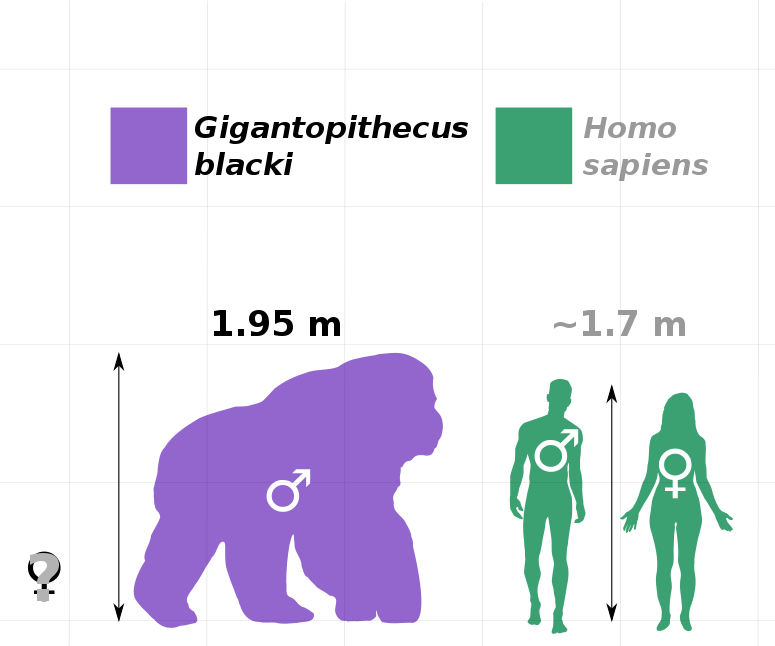
I'm still of the opinion that Yowies, Bigfoot, etc, are a cousin of Gigantopithecus. Apart from both sharing a lot of similarities in the looks and size department, they could have easily survived and/or evolved enough to hide out in the wilderness, slowly being driven towards populated areas due to urban sprawl.
Australopithecus (another extinct ape like creature, and off-shoot of convergent evolution from Gigantopithecus) is another contender.. and eventually a branch of the Australopithecus species eventually became early modern human.
Gigantopithecus
Australopithecus
Oh, and bonus picture. Notice the similarities?
https://upload.wikimedia.org/wikipedia/ ... v1.svg.png
..people don't tend to notice him standing there in the last frames..

-
Simon M
- Long Time Contributor
- Posts: 900
- Joined: Sun Sep 11, 2016 1:36 am
- Position: Unsure
- Location: Mostly at home
Re: LET ME EXPLAIN SOMETHING....MODUS OPERANDI
Yep, the similarities are definitely there, but until we can prove it's an ape I'm willing to keep an open mind on that issue. Whenever someone uses the whole 'yes, but hominins didn't leave Africa until such-and-such a point in time' argument, thinking it's a slam-dunk, I like to mention the idea that they need not be apes. It's a conversational version of upping the ante. 
Convergent evolution is provable, it happens, and it opens a whole new can of worms for the sceptic that he cannot easily dismiss. If people keep seeing these things (and they do) and apes 'cannot' exist in Australia due to whatever geological/evolutionary time-scale is accepted as fact, then why must they be apes?
Convergent evolution is provable, it happens, and it opens a whole new can of worms for the sceptic that he cannot easily dismiss. If people keep seeing these things (and they do) and apes 'cannot' exist in Australia due to whatever geological/evolutionary time-scale is accepted as fact, then why must they be apes?